
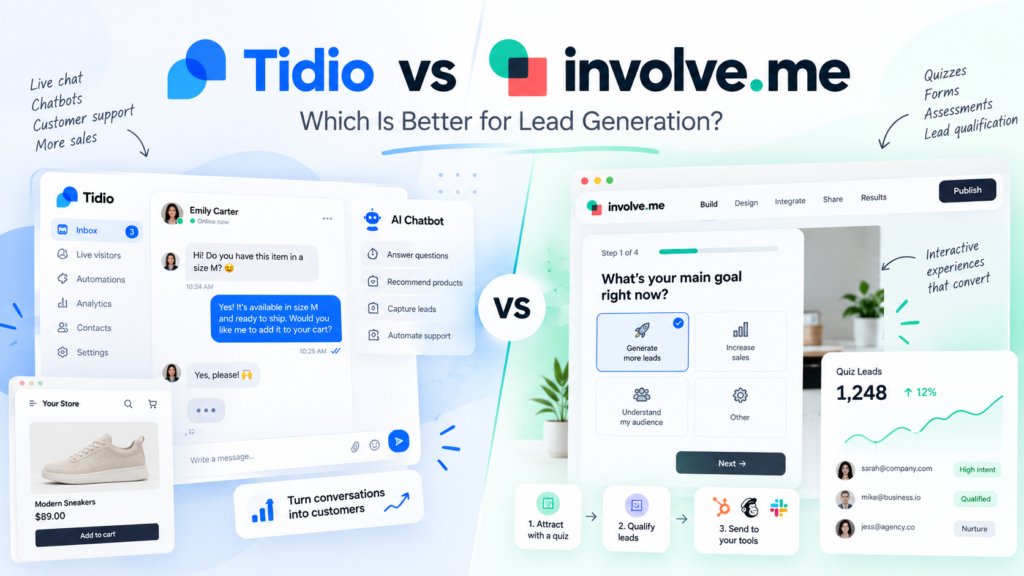
A visitor lands on your website. They’re interested, but not ready to buy.
What should happen next?
Should someone start a conversation and answer their questions? Or should your website guide them through a short quiz, understand their needs, and recommend the right next step?
That choice matters more than it sounds.
Tidio and involve.me can both help you capture leads, but they solve the problem in very different ways. Tidio approaches lead generation through conversations. involve.me approaches it through structured, interactive funnels.
One is built around what customers want to ask. The other is built around what your business needs to learn.
This Tidio vs involve.me comparison looks at the actual decision a small business faces: which approach makes sense for your visitors, your sales process, and your budget?
Affiliate disclosure: Vyneta participates in the Tidio and involve.me affiliate programs. We may earn a commission when you sign up or purchase through qualifying links, at no additional cost to you. Our recommendations are based on product fit, not commission rates.
Research transparency: This comparison draws on official product documentation, published pricing, and Vyneta’s existing product research. It is not a controlled head-to-head experiment. We have not measured conversion-rate improvements from deploying both tools on the same website.
Table of Contents
Quick Verdict: Which Tool Should You Choose?
Choose Tidio if potential customers have questions before buying, your team needs live chat or automated conversations, and support is closely connected to sales.
Choose involve.me if you want to ask visitors structured questions, qualify leads before passing them to sales, recommend products, or build interactive quizzes and assessments.
Neither is automatically better at generating leads. The more useful question is which interaction your visitors are willing to complete.
| Decision factor | Tidio | involve.me |
|---|---|---|
| Core experience | Conversations and chat | Interactive forms, quizzes, and funnels |
| Best for | Answering questions and capturing leads during conversations | Qualifying visitors through structured questions |
| Lead qualification | Chat-based questions and automation | Scoring, branching logic, and personalized outcomes |
| Human assistance | Live chat and agent handoff | Generally designed for self-service funnel experiences |
| Customer support | Core use case | Not a replacement for a help desk |
| Personalized recommendations | Conversational recommendations and automated flows | Outcome-based product recommendations and assessments |
| Free entry point | Free plan | Free plan |
| Primary consideration | Conversation volumes and automation allowances | Submissions, funnel limits, and advanced feature access |
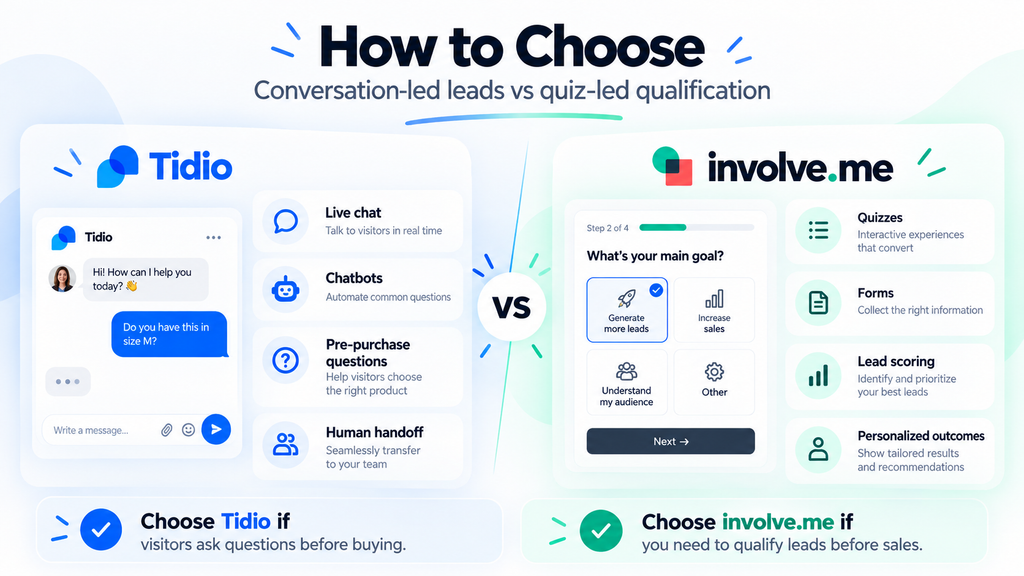
1. The Real Difference: Conversation vs. Qualification
Imagine two small businesses.
The first sells skincare products online. Customers frequently ask whether a product suits their needs, how long delivery takes, or what happens if something goes wrong.
The second sells consulting packages. Before arranging a consultation, the business needs to know each prospect’s budget, company size, main problem, and timeline.
Both businesses want more qualified leads.
But they shouldn’t necessarily use the same tool.
Where Tidio makes more sense
For the online store, a conversation can remove uncertainty at the moment it matters.
A visitor asks about delivery. An automated response provides the relevant information. The visitor asks a more complicated question, and a human agent can take over when necessary.
Tidio combines live chat, customer-service features, conversational automation, and lead capture.
Its Flows product can start interactions based on predefined triggers. Its Lyro AI Agent supports more advanced conversational scenarios, with availability and usage depending on the subscription and configuration.
For a business where customer questions regularly interrupt the buying process, that approach is compelling.
Where involve.me makes more sense
For the consulting business, starting a live chat with every visitor may not be productive.
The business needs a consistent way to understand whether someone is a good fit.
An involve.me assessment could ask:
- What problem are you trying to solve?
- How large is your team?
- When do you want to get started?
- What budget range are you considering?
The answers can help segment prospects and present different outcomes.
This doesn’t require pretending every visitor needs a conversation. It creates a guided route from interest to the appropriate next action.
Vyneta’s perspective: A useful lead-generation tool shouldn’t simply collect more email addresses. It should help your business understand what to do with them.
2. Lead Capture: Which Experience Fits Your Website?
Tidio and involve.me can both collect visitor information, but the experience feels different.
Tidio: Capture interest while answering a question
Tidio’s strength is that lead capture can happen within a conversation.
Someone already has a reason to engage. The tool can ask for contact details, continue with relevant questions, or direct the visitor toward an appropriate next step.
This is useful when visitors don’t necessarily arrive intending to complete a form.
The potential weakness is equally important: people who don’t want to chat may ignore the widget.
A chat interface is not automatically the best lead magnet for every audience.
involve.me: Give people a reason to complete a funnel
involve.me lets businesses create quizzes, forms, calculators, assessments, and other interactive experiences.
Rather than asking visitors to leave an email address immediately, the business can offer something specific in return:
- A product recommendation
- A service-fit assessment
- A preliminary quote
- A personalized result
- A guided buying decision
The challenge is designing a genuinely useful interaction.
A quiz with too many unnecessary questions can become another obstacle between the visitor and the answer they wanted.
The tool provides the mechanics. Your offer still has to justify the effort.
A practical decision
Ask what your visitors are doing immediately before they become leads.
If they’re asking questions, start by evaluating Tidio.
If they’re comparing options or trying to find the right solution, start by evaluating involve.me.
3. Lead Qualification: Which Tool Helps You Identify Better Prospects?
This is where the distinction becomes especially valuable.
A lead is not necessarily qualified just because someone submitted a form or started a chat.
A useful qualification process should reveal enough information to determine the next step.
Tidio’s qualification approach
Tidio can collect information through chat experiences and automated interactions.
Its conversational tools can support lead qualification and, in appropriate configurations, move qualified prospects toward a CRM or meeting-booking workflow.
The advantage is flexibility. Prospects can ask questions while providing information.
But businesses need to verify which AI actions, integrations, and automation features are available in their chosen plan.
Don’t assume that every capability shown on a vendor’s website is included in its free subscription.
involve.me’s qualification approach
Lead qualification is central to involve.me.
Its funnel tools support conditional questions, scoring, different outcomes, and integrations with external systems.
A business could use a score to distinguish between:
- Someone researching a problem
- Someone actively evaluating vendors
- Someone ready to request a consultation
Those distinctions can change what happens after submission.
A high-fit prospect might be shown a booking option. Another visitor might receive educational material instead.
However, advanced logic, integrations, and automation features are plan-dependent.
A free account is useful for exploration, but it doesn’t necessarily support the complete funnel you eventually want to publish.
The mistake I’d avoid
Don’t automatically send every lead to the same follow-up sequence.
Someone asking a basic question may need an explanation.
Someone who has already specified a budget and implementation timeline may be ready for a sales conversation.
The important metric isn’t just how many contacts you collect. It’s whether the next action fits the person’s needs.
4. Automation: Different Tools, Different Jobs
Both vendors use automation, but their starting points are different.
Tidio emphasizes automating parts of a customer conversation, including questions, responses, and selected next actions.
involve.me emphasizes automating a structured journey through questions, scoring, outcomes, and follow-up.
For example, imagine a visitor interested in a marketing service.
With Tidio, an automated conversation might answer questions, collect basic contact details, and direct the visitor toward a team member.
With involve.me, a funnel might ask about the visitor’s goals and budget, calculate a fit score, and show a relevant service recommendation.
Neither workflow is inherently superior.
The difference is whether the customer journey benefits more from conversation or structured decision-making.
5. Pricing: What Will You Actually Pay?
This comparison is more complicated than putting two starting prices beside each other.
Tidio’s pricing is influenced by its customer-service plans and separate allowances for conversational AI and Flows.
involve.me prices its product around funnel capabilities, user access, and usage limits.
Tidio pricing
At the time of this review, Tidio’s published customer-service pricing includes:
- Free: $0/month
- Starter: $24.17/month with annual billing
- Growth: starting at $49.17/month with annual billing
- Plus: starting at $300/month, plus applicable usage
- Premium: custom pricing
Additional AI or automation allowances may affect the final cost.
For lead generation, don’t compare only the Starter price. Check how many visitors your Flows can reach and whether your intended AI features require a separate allowance.
involve.me pricing
involve.me currently advertises:
| Plan | Monthly billing | Effective monthly price with annual billing |
|---|---|---|
| Free | $0 | $0 |
| Start | $49 | $29 |
| Grow | $99 | $69 |
| Scale | $199 | $139 |
| Enterprise | Custom contract | From $499 |
Its free offering has usage limits, including a published allowance of up to 50 submissions or 500 visits per month.
Higher plans unlock additional funnel capacity, integrations, branding options, and other capabilities.
Prices reflect published USD figures checked in October 2026. They may change; tax, promotional pricing, feature access, and billing terms should be verified before purchasing.
Which pricing model is better?
It depends on what creates value for your business.
If the primary benefit is helping customers through conversations, examine Tidio’s conversation and automation allowances.
If the benefit is qualifying prospects through interactive funnels, examine involve.me’s submission limits, funnel capacity, and feature tiers.
A cheaper subscription isn’t a better deal if its limits prevent you from running the workflow you actually need.
6. Which Is Easier for a Small Team?
Ease of use should be judged by how quickly you can build a useful workflow — and keep it working.
For Tidio, I’d evaluate the process of installing the chat widget, preparing responses, defining conversation triggers, and deciding when a human should take over.
For involve.me, I’d evaluate how quickly someone can build a quiz or assessment, create relevant outcomes, and connect submissions to an appropriate follow-up.
Both can be approachable without coding, but the ongoing work differs.
A chat-based system requires attention to response quality and support coverage.
A quiz funnel requires attention to questions, completion friction, scoring rules, and the usefulness of its results.
The one that’s easier is likely to be the one whose maintenance work fits naturally into your team’s responsibilities.
7. When Tidio Is the Better Fit
I’d start with Tidio when:
- Visitors regularly ask questions before purchasing.
- Customer support and sales overlap.
- Your store needs a visible live-chat option.
- You want to automate common questions without eliminating human assistance.
- You operate an ecommerce business where product and order questions influence buying decisions.
The main risk: Buying more conversational automation than your traffic or support process actually requires.
8. When involve.me Is the Better Fit
I’d start with involve.me when:
- Visitors need help choosing between services or products.
- Your sales process depends on qualifying questions.
- You want an interactive assessment or recommendation funnel.
- Lead scoring and segmentation matter more than live chat.
- You sell consultations, services, or offers where fit matters before a sales call.
The main risk: Building a sophisticated quiz that visitors don’t find worth completing.
9. The Test I’d Run Before Paying
Rather than comparing every feature, define one measurable task.
For Tidio:
Create a simple conversational flow around a common pre-purchase question. Check whether visitors can get an accurate answer and reach a human when necessary.
For involve.me:
Create a short qualification experience with no more questions than necessary. Check whether a visitor receives a useful outcome and whether your team can act on the collected information.
For both:
- Use the same clearly defined business objective.
- Test the mobile experience.
- Check the information collected.
- Examine the actual next step after the interaction.
- Review the relevant plan limits before publishing.
Don’t declare a conversion-rate winner based on one test visitor or a vendor’s demonstration.
If you later have enough real traffic to compare results, assess qualified leads and downstream outcomes — not only form starts or chat openings.
Final Verdict: Ask Better Questions, or Answer Them Better?
I wouldn’t choose between Tidio and involve.me by counting AI features.
I’d start with the behavior of the person visiting your website.
If they need reassurance, quick answers, or human assistance before buying, Tidio is the more natural starting point.
If they need help identifying the right product or your business needs to determine whether they’re a qualified prospect, involve.me deserves the first evaluation.
There is also a reasonable case for using both in a larger customer journey, provided each solves a distinct problem and the added cost is justified.
For a lean business, though, I’d start with one clearly defined use case.
The purpose of lead-generation software isn’t to make your website look more sophisticated.
It’s to help the right visitors take a useful next step.
Frequently Asked Questions
Is Tidio better than involve.me for lead generation?
Tidio may be a better fit when lead generation happens through conversations. involve.me is more suited to structured qualification flows, quizzes, and personalized outcomes. Neither is universally better.
Can involve.me replace Tidio?
Not as a general customer-support replacement. involve.me creates interactive funnels, but it isn’t designed to provide the same live-chat and help-desk experience as Tidio.
Can Tidio replace involve.me?
For simple conversational lead capture, Tidio may be sufficient. For advanced quiz funnels, scoring, calculators, or outcome-based assessments, involve.me may be more appropriate.
Do both offer free plans?
Yes. Both advertise free entry options with usage and feature limitations. Check their official pricing pages before committing.
Which tool is better for Shopify?
Tidio is a more natural candidate when the goal is helping shoppers through live chat and automated conversations. involve.me is worth evaluating when the store wants interactive product finders, quizzes, or lead qualification funnels.
Which is better for B2B lead qualification?
involve.me’s scoring and conditional-question workflows make it a strong candidate when structured qualification is central. Tidio may fit better if prospects expect to discuss requirements through chat before booking a call.