
Affiliate Disclosure: This review contains affiliate links. If you sign up through one of these links, Vyneta may earn a commission at no extra cost to you. This does not affect our editorial conclusions.
SEO is becoming harder to manage manually.
It is no longer just about updating title tags, publishing content, or building internal links. Modern websites also need to deal with technical SEO, JavaScript rendering, structured data, page speed, search visibility across multiple platforms, and increasingly, AI crawlers such as ChatGPT, Claude, and Perplexity.
That is the problem Alli AI is trying to solve.
Alli AI combines website-wide SEO automation with an AI Search Visibility Engine designed to make website content more accessible to both traditional search engines and AI crawlers. It can also deploy SEO changes without requiring marketers to edit the underlying CMS every time.
But it is not a cheap lightweight SEO plugin.
With paid plans starting in the hundreds of dollars per month, Alli AI makes the most sense when automation can replace meaningful manual work across multiple pages, sites, clients, or technically complex websites.
In this Alli AI review, we will look at its current features, pricing, strengths, limitations, and the types of businesses that are most likely to get real value from it.
Vyneta review note: This review is based on our analysis of Alli AI’s current product documentation, pricing, help resources, feature set, and available user feedback. We have not run a long-term production SEO campaign with Alli AI, so we do not claim ranking or traffic results that we have not independently verified.
In this Alli AI review, we’ll look at its core features, pricing, strengths, limitations, and who it’s best suited for in 2026.
Table of Contents
Alli AI Review: Quick Verdict
Alli AI is best viewed as an SEO deployment and search visibility automation platform, rather than simply another AI writing or keyword research tool.
Its strongest use case is reducing the gap between identifying an SEO issue and actually deploying the fix.
Instead of waiting for developers or editing hundreds of pages manually, teams can use Alli AI to apply optimization rules, make browser-based changes, automate internal linking and schema tasks, monitor rankings, and deploy changes across large numbers of pages.
Its newer AI Search Visibility Engine adds another layer: Alli AI can serve pre-rendered content to dozens of AI crawlers, which may be particularly useful for JavaScript-heavy websites whose content is not consistently accessible to non-browser crawlers.
The main drawback is price.
For a small WordPress site with one owner and a few dozen pages, Alli AI can easily be more infrastructure than you need. For agencies, ecommerce sites, SaaS companies, or teams managing large and technically fragmented websites, the economics can make much more sense.
Best for: SEO agencies, multi-site teams, ecommerce businesses, SaaS companies, and organizations with developer bottlenecks.
Less suitable for: very small websites, beginner bloggers, and businesses primarily looking for AI content generation.
What Is Alli AI?
Alli AI is an SEO automation and AI search visibility platform designed to let marketing and SEO teams optimize websites without repeatedly changing their underlying CMS or waiting for development resources.
Its current platform effectively combines two major functions.
The first is traditional SEO automation.
Alli AI can help teams deploy on-page SEO changes, optimize internal linking, generate schema markup, monitor keywords, improve page performance, test titles, and apply optimization rules across many pages.
The second is AI crawler visibility.
Its AI Search Visibility Engine detects supported search and AI crawlers and can serve them a pre-rendered version of website content. Alli AI currently says the system supports more than 50 search and AI crawlers.
This distinction matters.
Many SEO tools help you identify problems.
Alli AI is much more focused on executing changes at scale.
How Does Alli AI Work?
One of Alli AI’s main selling points is that businesses do not necessarily need to rebuild their website or replace their existing CMS.
The platform can be connected through methods including a WordPress integration, JavaScript snippet, tag manager, or other supported deployment methods. Alli AI says its system works across different CMSs and technology stacks.
Once connected, Alli AI can crawl the site, identify optimization opportunities, and allow teams to deploy changes through its interface.
Its Live Editor provides a more visual workflow.
Instead of opening the WordPress editor, Shopify theme, custom CMS, or developer environment every time you want to make an SEO adjustment, marketers can make certain changes directly through Alli AI and publish them through its optimization layer.
For larger websites, the bigger advantage comes from rules and bulk deployment.
One optimization rule can potentially be applied across many matching pages instead of repeating the same task manually.
Before automating changes across your website, plan a small, reversible test. Our free SEO Automation Pilot Kit helps you record a baseline, define approval checks and prepare a rollback plan before expanding.
Key Alli AI Features
1. AI Search Visibility Engine
The most interesting development in Alli AI’s current product is its AI Search Visibility Engine.
Traditional search crawling and AI crawling are not always identical.
Websites built heavily around client-side JavaScript can sometimes return incomplete content to crawlers that do not render the page in the same way a normal browser does.
Alli AI addresses this by detecting supported AI crawler requests and serving pre-rendered HTML containing the site’s content. The company currently lists support for more than 50 AI and search crawlers.
Alli AI has also introduced an LLM Mode that allows site owners to preview the structured version of content being presented to AI crawlers.
That is more useful than simply tracking whether a brand appears in AI answers.
It attempts to solve part of the technical accessibility problem behind AI visibility.
However, this needs to be interpreted carefully.
Making your content accessible to an AI crawler does not guarantee that ChatGPT, Claude, Gemini, Perplexity, or another AI system will cite or recommend your website.
Crawler accessibility is infrastructure.
Visibility and citations still depend on factors such as content quality, relevance, authority, entity signals, and the systems used by individual AI platforms.
2. Bulk On-Page SEO Automation
SEO teams often know what needs fixing.
The bottleneck is implementation.
Updating metadata across thousands of product pages, fixing repeated on-page issues, adding structured data, or applying the same SEO logic across multiple websites can consume significant development and operational resources.
Alli AI’s automation system is designed to let teams create rules and deploy changes across large numbers of pages.
The company positions this functionality particularly strongly for agencies, ecommerce stores, and larger sites where repeating the same optimization manually is inefficient.
This is one of the areas where Alli AI makes more sense as website scale increases.
If you only manage 20 pages, automation may save relatively little.
If you manage thousands of URLs, the same automation can have a much larger operational impact.
3. Live Editor
Alli AI’s Live Editor lets users modify SEO-related elements directly through the browser.
That can include content, titles, descriptions, and other page elements without requiring every change to go through the original website editor.
Changes can be previewed before publishing and deployed through Alli AI’s optimization layer.
This can be useful when:
your CMS is difficult to modify,
your development backlog is long,
you manage websites running on different platforms,
or your SEO team does not have direct access to source code.
For agencies managing clients across WordPress, custom CMSs, ecommerce platforms, and other stacks, having one optimization workflow can reduce operational complexity.
4. Internal Linking Automation
Internal linking sounds simple until a website contains hundreds or thousands of pages.
At that point, identifying relevant links, maintaining anchor text, and ensuring important pages receive enough internal authority becomes increasingly difficult.
Alli AI provides internal linking recommendations and automation designed to improve site connectivity and crawlability.
This is particularly relevant for large blogs, ecommerce catalogs, SaaS documentation sites, and publishers with growing content libraries.
It still requires editorial judgment.
Automatically suggested links should be reviewed for context and usefulness instead of being treated as inherently correct.
5. AI Schema Markup
Structured data remains one of the more technical parts of SEO implementation.
Alli AI includes schema markup functionality intended to generate and deploy relevant structured data without requiring teams to manually code every implementation.
That can reduce implementation friction.
However, automation does not remove the need to validate schema.
Incorrect or misleading structured data can cause problems even when the markup itself is technically valid.
For important pages, we would still recommend checking deployed markup against Google’s current structured data requirements.
6. SEO A/B Testing
Alli AI also offers SEO A/B testing for page titles.
The system can generate title variants and evaluate their performance using traffic and user behavior data, with the goal of finding stronger-performing title combinations.
This feature becomes more valuable when a website already receives enough traffic for meaningful testing.
On a very small site with limited impressions, the available data may not be sufficient to produce useful conclusions quickly.
7. Keyword Rank Tracking
Alli AI includes built-in keyword rank tracking.
Users can monitor rankings, ranking history, location-specific performance, and optimization progress from the platform. Alli AI’s documentation says ranking data is updated regularly and can be viewed alongside recommendations and optimization status.
This does not necessarily replace a full competitive SEO intelligence platform.
But having ranking data inside the same environment where optimizations are deployed can make workflows easier to manage.
8. Site Speed Optimization
Alli AI also includes site performance optimization capabilities.
Its feature set includes server-side rendering as well as image, font, and page-load optimization technologies.
Performance improvements are valuable, but speed claims should always be evaluated against the actual website.
A performance feature that dramatically improves one site may produce a much smaller improvement on another depending on hosting, caching, frontend architecture, and existing optimization.
Alli AI Pricing in 2026
Alli AI is not positioned as an inexpensive SEO tool.
At the time of this review, its pricing page lists a 10-day free trial across its plans.
The Business plan currently costs $299 per month when paid monthly, while the Agency plan costs $599 per month.
Annual billing reduces the effective monthly cost to approximately $249 per month for Business and $499 per month for Agency, billed annually.
Enterprise pricing is customized.
Business currently includes up to five sites, five team members, 500 keywords, and 1,250 pages.
Agency increases those limits to 15 sites, 15 team members, 2,000 keywords, and 5,000 pages, while also adding features such as API access and white-label snippet hosting.
Pricing can change, so check the latest plan details before purchasing.
Is Alli AI Expensive?
For a single small website, yes.
$299 per month is significant if you only need keyword tracking, basic audits, or occasional on-page optimization.
But software economics change when it replaces repetitive work.
An agency managing 15 client sites or an ecommerce team maintaining several thousand URLs may compare Alli AI’s subscription cost against developer time, SEO implementation hours, technical backlog, and manual QA rather than against a $20 WordPress plugin.
That is the better way to evaluate Alli AI.
Alli AI Pros and Cons
| Pros | Cons |
|---|---|
| Strong focus on SEO execution rather than recommendations alone | Expensive for small sites and solo bloggers |
| Can deploy optimizations across many pages | Requires careful review before large-scale automation |
| Works across different CMSs and technology stacks | Adds another optimization layer between your site and visitors/crawlers |
| AI crawler visibility addresses a newer technical SEO problem | AI crawler accessibility does not guarantee AI citations |
| Live Editor reduces dependence on developer queues | Some functionality may be unnecessary for simple WordPress sites |
| Combines SEO automation, rank tracking, schema, internal linking and performance tools | Not primarily an AI content creation platform |
| Useful for agencies and multi-site environments | Large-scale implementations deserve proper testing and rollback planning |
The Biggest Advantage: Execution
The clearest reason to consider Alli AI is not that it uses AI.
Plenty of SEO tools now use AI.
The more meaningful difference is its focus on shortening the distance between finding an SEO opportunity and deploying the change.
A conventional workflow might look like this:
SEO audit → recommendation → ticket → developer → staging → approval → deployment.
With Alli AI, certain types of optimization can instead move from recommendation to implementation through the same platform.
For organizations where technical implementation is the bottleneck, that can be more valuable than adding yet another tool that produces recommendations.
The Biggest Limitation: Platform Dependency
There is also a trade-off.
Some Alli AI optimizations are delivered through Alli AI’s own deployment layer rather than permanently rewriting every element inside your underlying CMS.
That means businesses should understand what happens to deployed changes if they later stop using the platform.
One Trustpilot reviewer specifically criticized this dependency, saying that optimizations delivered through the Alli AI layer disappeared after the subscription ended. That is one user’s experience rather than proof that every Alli AI implementation behaves identically, but it is a reasonable architectural question to investigate before adopting the platform broadly.
For large implementations, we would ask Alli AI exactly which changes are stored in the underlying CMS and which depend on its delivery infrastructure.
That should be part of the buying decision.
What Do Alli AI Users Say?
Public review volume is still relatively small compared with larger SEO platforms.
Recent independent reviews tend to praise Alli AI for reducing repetitive SEO work and simplifying website-wide optimization.
A 2026 Capterra review highlighted the ability to identify optimization opportunities and implement changes without spending as much time on manual SEO, while also noting an initial learning curve and some feature complexity.
Trustpilot currently shows a small number of reviews, with positive users frequently mentioning automation and productivity, alongside some negative feedback around platform dependency and perceived SEO impact. Because the sample is limited, we would not treat the aggregate score alone as strong evidence of product quality.
That mixed picture is useful.
Alli AI appears strongest when automation itself solves a real operational problem.
Simply installing it should not be expected to produce rankings automatically.
Is Alli AI a Good SEO Automation Tool?
Alli AI is most relevant for teams that already understand what needs to be fixed but want to reduce the manual work involved in SEO implementation. As an SEO automation tool, it is better suited to repeated on-page changes, internal linking, schema, and site-wide optimization tasks than to replacing strategy or content planning. For businesses comparing AI SEO tools, the main question is whether automation can save enough implementation time to justify adding another platform to the stack.
If you are still comparing whether automation is right for your workflow, read our guide on how to choose an SEO automation tool.
For a practical implementation workflow, see our guide on how to automate SEO with Alli AI.
Who Is Alli AI Best For?
Alli AI is particularly compelling for organizations where SEO implementation does not scale well manually.
That includes:
- SEO agencies managing multiple clients.
- Ecommerce stores with large product catalogs.
- SaaS companies operating multiple web properties.
- Marketing teams blocked by development queues.
- Businesses using technically complex or JavaScript-heavy websites.
- Teams trying to improve accessibility to AI search crawlers.
- Organizations managing SEO across several CMS platforms.
For those users, the cost may be easier to justify because the platform can reduce implementation time across many URLs or websites.
Who Should Probably Skip Alli AI?
Alli AI will not be the best fit for everyone.
A small WordPress website with 30 pages and one person managing SEO can already handle many optimization tasks with WordPress, Rank Math or another SEO plugin, Search Console, and a relatively simple editorial workflow.
Paying several hundred dollars per month purely to automate a small number of changes would be difficult to justify.
Likewise, if your main problem is producing better articles rather than deploying SEO changes, Alli AI may not solve the bottleneck you actually have.
The right question is therefore not:
“Is Alli AI powerful?”
It clearly has a substantial feature set.
The better question is:
“Do I have enough SEO implementation work for automation to save more than it costs?”
Alli AI and AI Search: Useful Infrastructure, Not a Ranking Shortcut
The AI search component deserves special attention because this market is moving quickly.
Alli AI’s approach is technically interesting.
If an AI crawler cannot properly access your JavaScript-rendered content, making that content available as structured, pre-rendered HTML addresses a genuine accessibility problem. Alli AI’s AI Visibility Engine is specifically designed around that use case.
But marketers should avoid turning that into a stronger claim than the technology supports.
Making your page crawlable does not automatically make the page authoritative.
It does not guarantee citations.
And it does not eliminate the need for useful content, credible sources, clear entities, strong product information, backlinks, brand signals, and good technical SEO.
Think of crawler enablement as removing a technical barrier.
It is not a replacement for the rest of SEO or GEO.
Is Alli AI Worth It in 2026?
For the right company, Alli AI solves a much more valuable problem than simply generating another SEO checklist.
It helps teams execute SEO work at scale.
That makes it most attractive to agencies, ecommerce operations, SaaS teams, and businesses managing large or technically complicated websites.
Its newer AI Search Visibility Engine also makes the platform more differentiated in 2026, particularly for JavaScript-heavy websites concerned about how their content is being accessed by AI crawlers.
The biggest barrier is the price.
At roughly $299 per month for the entry Business plan when paying monthly, a small site needs a strong reason to adopt it.
For a larger team, however, the correct comparison is not necessarily Alli AI versus a cheap SEO plugin.
It is Alli AI versus the hours spent manually implementing changes, maintaining multiple workflows, and waiting for technical resources.
If SEO execution is already one of your bottlenecks, Alli AI is worth putting through its free trial.
If your website is small and your implementation workload is light, you can probably achieve more value with a simpler SEO stack.
How Vyneta Is Affiliated With Alli AI
Vyneta participates in the Alli AI affiliate program through Reditus. At the time of publication, our account shows a 20% commission rate, a 12-month commission period, a 60-day cookie window, and a $50 payout threshold. Paid search advertising is permitted except on the Alli AI brand name.
These commercial terms do not change how we evaluate the product. Our review focuses on whether Alli AI makes sense for the reader based on its features, pricing, limitations, and intended use cases.
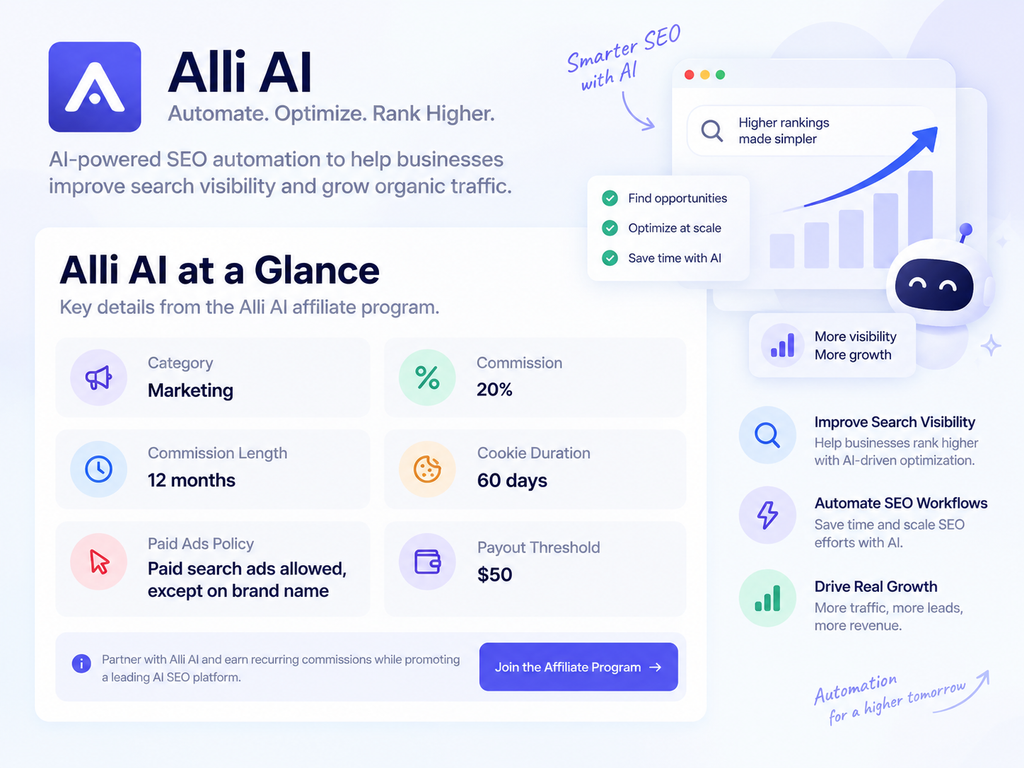
Affiliate program snapshot for transparency. This is an editorial illustration based on Vyneta’s Reditus account data, not an Alli AI product-interface screenshot.
If you’d like to explore more tools for lean online businesses, browse our other software reviews on Vyneta.
Alli AI FAQ
Does Alli AI replace an SEO expert?
No.
Alli AI can automate and deploy many SEO tasks, but someone still needs to decide which recommendations make sense, evaluate strategy, review automated changes, and measure business results.
Automation reduces execution work. It does not remove the need for SEO judgment.
Does Alli AI work with WordPress?
Yes.
Alli AI provides a WordPress integration for its AI Visibility Engine, and its broader platform is designed to work with multiple CMSs and technology stacks.
Can Alli AI help with AI search visibility?
Alli AI’s AI Search Visibility Engine is designed to serve pre-rendered content to more than 50 supported AI and search crawlers, including crawlers associated with platforms such as ChatGPT, Claude and Perplexity.
This can improve crawler accessibility, but it does not guarantee that an AI platform will cite or recommend your website.
How much does Alli AI cost?
At the time of this review, Business costs $299 per month on monthly billing and Agency costs $599 per month. Annual billing lowers the effective monthly rates to approximately $249 and $499 respectively. Enterprise pricing is customized. A 10-day free trial is currently available.
Is Alli AI suitable for small businesses?
It can be, but value depends heavily on website scale.
A small business with a large ecommerce catalog, multiple sites, or significant technical SEO bottlenecks may benefit.
Overall, this Alli AI review shows that the platform is best suited to teams that need SEO automation at scale rather than a lightweight SEO plugin.
A very small informational website with simple WordPress SEO requirements may struggle to justify the subscription cost.