
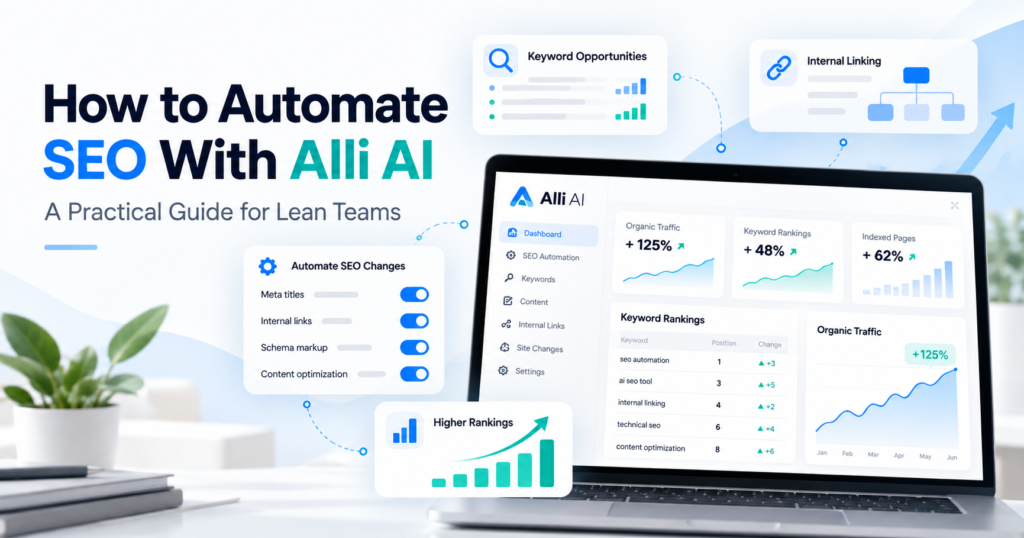
Learning how to automate SEO with Alli AI can help lean teams reduce repetitive SEO work without giving up control over strategy. SEO gets messy fast when a small team is responsible for too many pages.
You may know what needs fixing: missing meta descriptions, weak internal links, inconsistent on-page elements, pages that need technical cleanup. The problem is usually not identifying every issue. It is finding enough time to implement the changes without turning SEO into a full-time maintenance job.
That is where SEO automation becomes useful.
Instead of replacing strategy, a tool like Alli AI is designed to reduce the repetitive work between finding an SEO issue and actually deploying a fix. Its current platform focuses on on-page automation, live editing, internal linking, schema, rank tracking, site-speed tools, and newer AI-search visibility features. Alli AI
This guide explains how a lean online business can use Alli AI in a practical workflow without handing every SEO decision over to automation.
Affiliate Disclosure: This article contains affiliate links. If you sign up through one of these links, Vyneta may earn a commission at no extra cost to you. This does not affect our editorial conclusions.
Table of Contents
What SEO Automation Actually Means
SEO automation is often misunderstood.
It does not mean pressing one button and letting software “do SEO” for you.
A better way to think about it is this:
Automation handles repeatable execution. You still decide what is worth doing.
For example, if you have 200 product or content pages with similar metadata problems, manually editing every page is inefficient. A rule-based SEO workflow can help you apply changes at scale, preview them, and roll them out faster.
Alli AI positions its automation around this type of work. Its platform can apply on-page changes across many pages and lets users create rules based on URL patterns or site conditions. It also includes a visual editor for making SEO changes without relying entirely on a CMS or developer workflow. Alli AI
That makes the tool most interesting when the bottleneck is not SEO knowledge, but implementation.
What Alli AI Can Automate
Alli AI currently covers several areas that are relevant to small teams, agencies, and site owners managing more pages than they can comfortably optimize by hand.
1. On-Page SEO Changes
Alli AI can help deploy on-page optimizations across multiple pages.
Typical use cases include:
- title tag updates
- meta description changes
- page-level SEO edits
- code-level adjustments
- rules that apply changes across matching URLs
Its official automation workflow is built around reviewing recommendations, approving the changes you want, and then publishing those changes to the site. Alli AI
This is where automation can save the most time.
Editing one title tag manually is easy.
Editing hundreds is not.
2. Internal Linking
Internal links are useful for helping search engines discover relationships between pages and for guiding readers toward relevant content.
The problem is that internal linking becomes harder to manage as a site grows.
Alli AI includes internal-linking automation and recommendations, including suggested anchor text and link opportunities. Alli AI
For a smaller site, you may still prefer to review links manually. That is usually a good idea.
The value comes from using automation to surface opportunities rather than expecting every suggested link to be worth publishing.
3. Schema Markup
Schema can be useful, but manually implementing structured data across a large site can become repetitive.
Alli AI includes AI-assisted schema markup tools designed to generate and deploy structured data without requiring the user to edit every page individually. Alli AI
Again, automation does not remove the need for review.
You still need to make sure the schema reflects what is actually on the page.
4. Keyword Rank Tracking
Alli AI also tracks keyword rankings.
Its help documentation says rankings are updated daily, and users can review ranking history, recommendations, optimization progress, and traffic estimates for tracked keywords. Trung Tâm Trợ Giúp Alli
This is useful because automation without measurement is not very helpful.
You need a way to see whether the pages you changed are actually moving in the right direction.
5. Site Speed Optimization
The platform also includes a Site Speed Optimizer.
Alli AI describes this as a way to improve page delivery and rendering across different site stacks. Alli AI
For lean teams, this can be attractive because performance work often requires more technical involvement than basic on-page SEO.
Still, site-speed changes should be tested carefully.
Performance tools can affect caching, rendering, scripts, and layout behavior. Never assume a speed optimization is harmless just because it is automated.
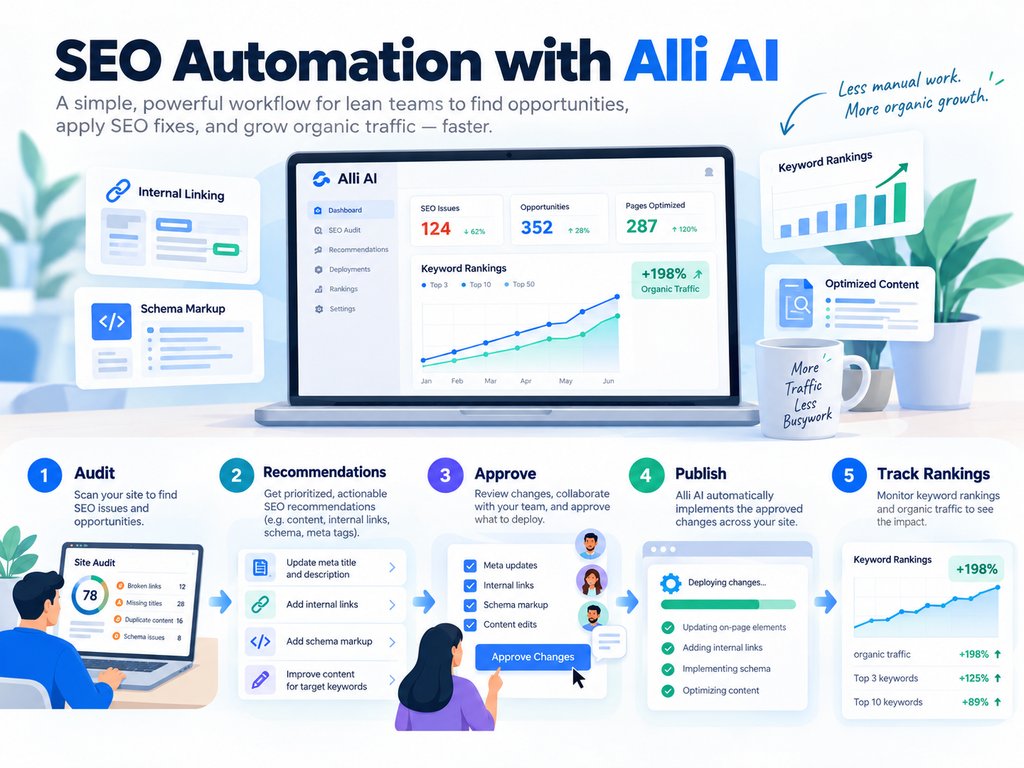
How to Automate SEO With Alli AI: A Practical Workflow
The biggest mistake with SEO automation is trying to automate everything at once.
A safer workflow is much simpler.
Step 1: Add One Site First
Start with one website.
Do not connect every property you manage on day one.
Alli AI’s setup process begins with adding your site and configuring the platform around the domain you want to optimize. Its documentation also allows users to specify country, language, and target keywords. Trung Tâm Trợ Giúp Alli
For a lean business, one site gives you enough data to understand how the system behaves before scaling it.
Step 2: Add a Small Set of Important Keywords
Do not dump hundreds of keywords into the platform immediately.
Start with keywords connected to pages that matter commercially.
For example:
- product pages
- comparison pages
- high-intent guides
- pages already receiving impressions
- pages close to ranking on page one
Alli AI lets users track keywords and review ranking history, optimization progress, and related recommendations in its Help Center documentation.
The goal is to improve a focused group first.
Step 3: Review Recommendations Before Publishing
This is the most important habit.
Do not approve every recommendation automatically.
Check whether the suggested change:
- matches search intent
- keeps the page readable
- fits your positioning
- preserves important keywords naturally
- avoids exaggerated claims
- makes sense for real users
Alli AI’s own FAQ describes the workflow as reviewing recommendations first, editing suggested text if needed, and then approving changes for publication. Alli AI
That review step should never disappear.
Step 4: Automate Repetitive Patterns
This is where Alli AI becomes more useful.
Look for repetitive SEO problems rather than isolated problems.
For example:
- a group of pages missing meta descriptions
- pages under the same directory needing similar rules
- repeated internal-linking gaps
- template-level on-page issues
- similar optimization opportunities across a category
Alli AI supports rule-based automation and large-scale on-page deployment, which is better suited to this kind of repetitive work than one-off editing. Alli AI
The rule is simple:
Automate patterns, not judgment.
Step 5: Monitor Rankings After Changes
Do not publish 500 changes and immediately move on.
Watch what happens.
Check:
- ranking movement
- impressions
- CTR
- organic traffic
- crawl/indexing behavior
- page engagement
- conversion performance
If rankings improve but conversions fall, the optimization may have targeted the wrong intent.
If CTR improves but engagement drops, the title may be attracting clicks without matching the page.
SEO automation should make iteration faster, not make analysis unnecessary.
Where You Should Still Work Manually
There are several areas where human judgment still matters more than automation.
Content Strategy
A tool can identify optimization opportunities.
It cannot decide which market is worth entering, which product is commercially attractive, or which topic fits your business model.
Those are strategic decisions.
Search Intent
Two keywords can look similar and still represent completely different users.
For example:
“SEO automation tool”
and:
“free SEO title generator”
both relate to SEO software.
But the buying intent is very different.
Automation should not treat them as interchangeable.
Product Comparisons
Comparison content requires context.
The reader wants to understand trade-offs, pricing logic, use cases, limitations, and who each product is for.
That requires editorial judgment, not just optimization rules.
Claims and Accuracy
Never let automation publish claims you have not verified.
This matters especially for:
- pricing
- guarantees
- performance claims
- integrations
- product availability
- plan limits
Software products change frequently.
Your content should reflect what is actually available now.
A Lean SEO Workflow Using Alli AI
If you want to automate SEO with Alli AI without overcomplicating your workflow, start small and expand only after you can measure the results.
For a small online business, I would keep the workflow simple.
Weekly
Review:
- ranking changes
- new optimization recommendations
- pages losing visibility
- internal-link opportunities
Approve only changes that make sense.
Every Two Weeks
Choose one repeated problem.
For example:
- weak titles
- missing descriptions
- poor internal links
- underoptimized category pages
Create or refine one automation rule.
Monthly
Review results at the page level.
Ask:
- Which automated changes improved performance?
- Which had no measurable effect?
- Which should be rolled back?
- Which patterns should be expanded?
This avoids the common mistake of treating automation as permanent once it is enabled.
The best way to automate SEO with Alli AI is to use automation for repetitive execution while keeping strategy, search intent, and quality control in human hands.
What About AI Search Visibility?
Alli AI has also expanded beyond traditional SEO automation.
Its current positioning includes an AI Search Visibility Engine designed to make website content more accessible to AI crawlers such as ChatGPT, Claude, Perplexity, and other AI search systems. Alli AI
The platform includes an LLM Mode that lets site owners preview what an AI crawler receives instead of what a human visitor sees. Trung Tâm Trợ Giúp Alli
This is interesting, but it should not distract from basic SEO.
A site still needs:
- useful content
- clear structure
- good internal linking
- crawlable pages
- strong search intent alignment
AI visibility is an additional layer, not a replacement for those fundamentals.
Who Should Consider Alli AI?
Alli AI makes the most sense when manual implementation is becoming the bottleneck.
That can include:
- small teams managing many pages
- agencies managing several client sites
- ecommerce sites with repeated templates
- publishers with growing content libraries
- marketers blocked by slow development workflows
If you only manage a ten-page website and make a few SEO updates per month, a full automation platform may be more than you need.
But when the number of repetitive changes starts growing faster than your team can implement them, automation becomes much easier to justify.
If you are deciding whether automation fits your team before choosing a platform, see our guide on how to choose an SEO automation tool.
For a closer look at the platform itself, including its features, pricing considerations, strengths, and limitations, read our Alli AI review.
Common Mistakes to Avoid
Automating Before You Have a Strategy
Do not automate a bad SEO plan.
You will simply execute the wrong strategy faster.
Approving Everything
Recommendations are inputs.
They are not instructions.
Review them.
Optimizing Only for Rankings
Rankings matter, but traffic quality matters more.
A keyword that ranks well but attracts the wrong user may still be a poor target.
Ignoring Conversion Data
SEO should ultimately support a business objective.
Track what visitors do after they arrive.
That may include:
- trial signups
- product clicks
- affiliate clicks
- leads
- purchases
Scaling Too Early
Test a workflow on a small group of pages first.
Once you understand the impact, scale it.
Is SEO Automation Worth It for a Small Team?
It can be.
But the value comes from removing repetitive execution work, not replacing SEO thinking.
A small team can use Alli AI to speed up on-page deployment, internal linking, schema work, rank monitoring, and other recurring tasks while keeping strategy and quality control in human hands.
That is the balance that makes SEO automation useful.
If your main problem is knowing what SEO is, automation will not solve it.
If your main problem is that you already know what needs doing but cannot implement it fast enough, Alli AI becomes much more interesting.
You can try Alli AI for your own SEO workflow and see whether the automation saves enough time to justify adding it to your stack.