
Disclosure: This review contains affiliate links. If you purchase through them, Vyneta may earn a commission at no extra cost to you. Our evaluation is based on hands-on testing, official product documentation, and suitability for different types of businesses.
In this Gorgias review, we tested the platform’s onboarding, Inbox, AI Agent setup, Shopify requirements, pricing, and ecommerce support workflow to see who it is really best for.
Table of Contents
Quick Verdict
Gorgias is one of the strongest customer support platforms for ecommerce businesses that run primarily on Shopify.
Its biggest advantage is not simply live chat or ticketing. It is the way Gorgias connects customer support directly to ecommerce data, including orders, customers, shipping information, refunds, cancellations, and product information.
We created a Gorgias account and tested its onboarding, helpdesk dashboard, Inbox structure, AI Agent setup, and overall workflow.
However, we did not connect a live Shopify store during our test. That means we were able to evaluate the platform and AI setup process, but we could not fully test Gorgias AI Agent in production.
This limitation is important because Gorgias currently requires a connected Shopify store to use AI Agent.
Best for: growing Shopify stores that handle enough customer support volume to justify a dedicated ecommerce helpdesk.
Vyneta rating: 8.6/10
What Is Gorgias?
Gorgias is an ecommerce-focused customer support platform that combines ticketing, live chat, email, social messaging, automation, AI, and ecommerce data in one helpdesk.
Unlike a general-purpose support tool, Gorgias is built heavily around ecommerce workflows.
When connected to Shopify, support agents can see information such as:
- Customer details
- Order history
- Shipping information
- Fulfillment status
- Purchase data
Agents can also perform certain Shopify actions directly from Gorgias instead of constantly switching between the helpdesk and Shopify admin.
This ecommerce focus is the main reason Gorgias is different from lighter customer-support tools.
How We Tested Gorgias
For this Gorgias review, we created a real Gorgias account and went through the onboarding process ourselves.
Our test included:
- Creating a Gorgias workspace
- Reviewing ecommerce platform onboarding
- Entering the Helpdesk dashboard
- Exploring the Inbox
- Reviewing ticket organization
- Opening the AI Agent setup
- Checking Shopify requirements
- Reviewing pricing and billing structure
- Comparing the workflow with Tidio
During onboarding, Gorgias asked which ecommerce platform we used.
Because our test website was not a Shopify store, we selected Other.
We were still able to enter the Helpdesk and explore the Inbox.
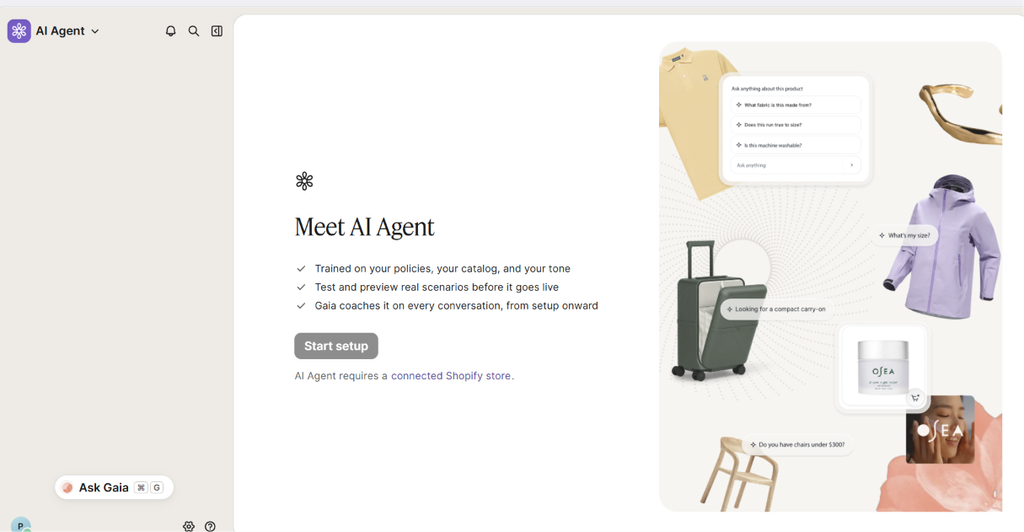
However, when we opened AI Agent, Gorgias displayed an important requirement:
AI Agent requires a connected Shopify store.
We therefore stopped the setup instead of connecting an unrelated live ecommerce store simply to unlock more features.
That gives this review an important boundary: our hands-on experience covers Gorgias onboarding and the helpdesk environment, while our analysis of deeper Shopify and AI functionality also relies on Gorgias’ official documentation.
Gorgias Setup and Ease of Use
Gorgias onboarding is polished, but it feels more ecommerce-specific than Tidio.
The platform immediately tries to understand:
- Your ecommerce platform
- Your support channels
- Your store
- Your customer-support workflow
This makes sense because Gorgias is designed around store data.
For an established Shopify merchant, that can be an advantage.
For a solopreneur with a simple WordPress site or a non-ecommerce business, it introduces more setup than may be necessary.
The main dashboard is relatively clean and currently includes areas such as:
- Inbox
- AI Agent
- Convert
- Analytics
- Workflows
- Customers
- Settings
We found the structure logical, although Gorgias clearly assumes you are managing real customer-support operations rather than simply adding a basic chat widget.
Gorgias Inbox: Built Around Tickets
The Gorgias Inbox felt more like a dedicated operational helpdesk than a lightweight messaging tool.
During our test, the Inbox included views such as:
- Assigned to me
- Unassigned
- All
- AI Agent
- Shared views
- Private views
We also received a sample onboarding ticket from Gorgias, which made it easy to understand how conversations appear in the system.
The interface separates the ticket list, conversation, and customer details.
This layout should be familiar to support teams that regularly work through queues of customer inquiries.
For a one-person store with only a handful of customer emails each month, this may be more system than you need.
For a growing ecommerce business, the structure makes much more sense.
Shopify Integration Is Gorgias’ Biggest Strength
This is where Gorgias becomes significantly more interesting.
Connecting Shopify gives the helpdesk access to customer order history, shipping details, purchase data, and customer profiles directly beside support tickets.
This reduces one of the most repetitive parts of ecommerce support:
customer asks a question → agent opens Shopify → searches the customer → finds the order → returns to the support tool → replies.
With Gorgias, much of that context can exist in one workspace.
Depending on permissions and configuration, agents can also perform Shopify actions such as:
- Cancel orders
- Refund orders
- Duplicate orders
- Edit certain order information
- Create orders
- Generate discount codes
Gorgias also supports Shopify data inside macros and automation workflows.
For stores processing meaningful support volume, this can save considerable operational time.
Gorgias AI Agent
AI Agent is one of Gorgias’ most important newer capabilities.
Instead of simply answering generic FAQs, Gorgias is positioning AI Agent as an ecommerce support system that can use store data, business knowledge, and predefined instructions.
Official documentation explains that AI Agent can work with brand policies, website knowledge, Shopify information, Guidance, Skills, and Actions.
That makes the system more operational than a simple FAQ chatbot.
Shopify Requirement
The limitation is clear:
A connected Shopify store is currently required to use Gorgias AI Agent.
Gorgias’ documentation also states that AI Agent is not currently supported for BigCommerce, Magento, WooCommerce, or PrestaShop in the same way.
This is a major consideration.
If you are a Shopify merchant, the tight integration is a strength.
If you are not on Shopify, one of Gorgias’ most valuable capabilities may not be available to you.
What Can Gorgias AI Agent Actually Do?
The interesting part of Gorgias AI Agent is that it can go beyond answering questions.
Using Actions, AI Agent can perform certain tasks inside connected ecommerce systems.
Gorgias documents Shopify Actions that can handle scenarios such as:
- Cancelling an order
- Updating a shipping address
- Removing an item
- Replacing or reshipping an order
These Actions allow the AI to resolve some customer requests without waiting for a human support agent.
That is potentially much more valuable than an AI chatbot that only returns text answers.
For a high-volume Shopify store, automating repetitive requests such as order changes or shipping questions could reduce workload substantially.
For a small store with 20 customer questions per month, the economics may be less compelling.
Gorgias Pricing in 2026
Gorgias pricing works differently from many helpdesks because the core Helpdesk is primarily based on ticket volume rather than simply charging for every agent seat.
Gorgias’ May 2026 pricing guide lists the following starting monthly prices:
| Plan | Monthly price | Included tickets |
|---|---|---|
| Starter | $10 | 50 |
| Basic | $60 | 300 |
| Pro | $360 | 2,000 |
| Advanced | $900 | 5,000 |
| Enterprise | Custom | Custom |
Pricing and plan details can change, so verify the current information on the official Gorgias pricing page before purchasing.
This creates a very low entry price with Starter, but costs increase quickly as support volume grows.
The pricing model therefore needs to be evaluated based on ticket volume, not simply the headline subscription price.
How Gorgias Billing Works
A Helpdesk ticket becomes billable when at least one message is sent from Gorgias.
That message may come from:
- A human agent
- AI Agent
- An automated Rule
Gorgias then charges an additional automation fee when AI Agent fully resolves a conversation without handing it to a human.
This means businesses need to understand two different usage concepts:
Helpdesk tickets
and
AI-resolved interactions
The pricing model makes sense once understood, but it is less simple than paying one flat monthly subscription.
How Much Does AI Agent Cost?
Gorgias currently prices AI Agent based on successfully resolved interactions.
According to Gorgias’ May 2026 pricing explanation, most plans cost approximately $0.90 per AI-resolved interaction, while Starter begins around $1 per resolved interaction. Higher-volume plans can include larger monthly allowances.
The important concept is that Gorgias does not simply charge every time AI sends a message.
The automation fee applies when AI Agent resolves the conversation by itself.
That aligns cost more closely with an outcome, but businesses with high customer-support volume should still model their expected usage carefully.
Gorgias Pros and Cons
Pros
Deep Shopify integration
Customer and order information can be available directly alongside support conversations.
Strong ecommerce workflow
Gorgias is designed around real store operations rather than generic website chat.
Powerful ticket organization
Inbox views and ticket workflows are suitable for growing support teams.
AI Agent can perform actions
The AI can potentially do more than answer questions by taking certain Shopify actions.
Pricing is not primarily per agent
Larger teams may benefit from ticket-based pricing compared with products that charge heavily per support seat.
Built for ecommerce
For the right Shopify merchant, this specialization is a major advantage.
Cons
AI Agent currently depends heavily on Shopify
This substantially reduces the value proposition for non-Shopify businesses.
Pricing rises quickly with ticket volume
Moving from Basic to Pro is a significant jump.
AI usage creates another cost layer
Businesses need to understand both ticket usage and AI-resolved interactions.
Probably excessive for very small stores
A simple business receiving only a few support questions may not need this much infrastructure.
Setup is more involved than lightweight chat tools
The ecommerce integration is powerful precisely because it requires deeper configuration.
Who Is Gorgias Best For?
Based on our testing and research, Gorgias makes the most sense for:
- Shopify stores
- Growing ecommerce businesses
- Businesses handling hundreds or thousands of support tickets
- Teams that frequently need order information during support
- Stores wanting deeper customer-service automation
- Ecommerce brands where support affects retention and revenue
- Teams that want multiple agents working from one helpdesk
The more operationally important customer support becomes, the stronger Gorgias’ value proposition becomes.
Based on this Gorgias review, the platform makes the most sense for Shopify businesses where customer support is becoming a meaningful part of daily operations.
Who Should Probably Skip Gorgias?
Gorgias may not be the best fit if:
- You are not using Shopify
- You run a content website rather than an ecommerce store
- You only receive a handful of support inquiries
- You mainly need a simple live-chat widget
- Your budget is very limited
- You want the simplest possible AI support setup
For those users, a lighter product such as Tidio may be more practical.
For a detailed comparison, read our Tidio vs Gorgias comparison.
Gorgias vs Tidio: Which Is Better?
These products overlap, but they are aimed at somewhat different stages of customer support.
Tidio gives small businesses a simpler way to combine:
- Live chat
- Ticketing
- AI support
- Website knowledge
- Automation
We were able to deploy Tidio and Lyro directly on a WordPress website without connecting an ecommerce store.
Gorgias, by contrast, makes much more sense when Shopify sits at the center of the business.
Its biggest strengths are:
- Ecommerce data
- Shopify actions
- Ticket operations
- Store-aware AI
- Customer-support workflows
Our practical conclusion is:
Choose Tidio if you want easier, lighter customer support.
Choose Gorgias if you run a growing Shopify business and need customer support connected deeply to ecommerce operations.
You can also read our full Tidio review for more details about our hands-on test of Lyro and the Tidio WordPress integration.
Is Gorgias Worth It?
For a growing Shopify merchant, yes — Gorgias can be worth it.
The platform solves a real operational problem: customer-support teams often spend too much time moving between email, live chat, social channels, ecommerce data, and order-management screens.
Gorgias brings many of those tasks into one system.
Its AI Agent also has more potential than a simple chatbot because it can eventually perform ecommerce actions rather than only returning answers.
However, that specialization is also Gorgias’ biggest limitation.
If you are not using Shopify, or your customer-support volume is very low, you may pay for complexity that you do not need.
For a small Shopify store just getting started, the Starter or Basic tiers can provide an entry point.
For larger stores with meaningful ticket volume and repetitive customer requests, Gorgias becomes significantly more compelling.
Overall, our Gorgias review found that the platform delivers the most value when Shopify, customer support, and ecommerce operations need to work closely together.
Vyneta rating: 8.6/10
Gorgias FAQ
Is Gorgias only for Shopify?
The Gorgias Helpdesk supports integrations beyond Shopify, but its current AI Agent functionality requires a connected Shopify store. Gorgias documentation says AI Agent is not currently supported for BigCommerce, Magento, WooCommerce, or PrestaShop in the same way.
How much does Gorgias cost?
As of 2026, Gorgias lists Starter from $10/month, Basic at $60/month, Pro at $360/month, Advanced at $900/month, and Enterprise with custom pricing. Pricing is based primarily on ticket volume.
Does Gorgias charge per agent?
Gorgias primarily scales Helpdesk pricing by ticket volume rather than using a traditional per-seat model. Its current pricing page says Helpdesk scales from 50 to 5,000 monthly tickets and is not priced per agent.
Does Gorgias have an AI chatbot?
Yes. Gorgias offers AI Agent, which can answer customer questions and use ecommerce data, Guidance, Skills, and Actions to automate certain support workflows.
Can Gorgias AI Agent modify Shopify orders?
Depending on configuration, Gorgias AI Agent Actions can perform tasks such as cancelling orders, updating shipping addresses, removing products, and handling other Shopify-related requests.
Is Gorgias better than Tidio?
For Shopify-focused ecommerce operations, Gorgias offers deeper ecommerce functionality.
For solopreneurs, WordPress businesses, and smaller businesses that want a simpler live-chat and AI-support setup, Tidio is generally easier to deploy.