
Disclosure: This comparison contains affiliate links. If you purchase through them, Vyneta may earn a commission at no extra cost to you. Our recommendations are based on hands-on testing, product research, and suitability for different types of businesses.
Table of Contents
Quick Verdict
If you run a small online business and want live chat, ticketing, and AI support without building a complicated ecommerce support stack, Tidio is the easier choice.
If your business is built around Shopify and customer support is becoming a serious ecommerce operation, Gorgias is the stronger platform.
That is the main difference we found.
We tested Tidio on a real WordPress website, including its live chat widget, Lyro AI Agent, knowledge sources, custom AI guidance, and frontend setup.
We also created a Gorgias account and reviewed its onboarding, helpdesk Inbox, AI Agent setup requirements, and Shopify-focused workflow. We did not connect a live Shopify store to Gorgias, so we could not fully test its AI Agent in production.
Our recommendation:
- Choose Tidio for solopreneurs, small online businesses, WordPress sites, and smaller ecommerce stores that want an easier path into AI customer support.
- Choose Gorgias for Shopify-focused ecommerce businesses that need deeper order context, ticket workflows, and ecommerce-specific AI automation.
Tidio vs Gorgias at a Glance
| Category | Tidio | Gorgias |
|---|---|---|
| Best for | Solopreneurs, SMBs, smaller ecommerce | Shopify-focused ecommerce teams |
| Live chat | Yes | Yes |
| Ticketing | Yes | Yes |
| AI support | Lyro AI Agent | Gorgias AI Agent |
| WordPress-friendly | Strong — official plugin | Helpdesk possible, but AI Agent is Shopify-focused |
| Shopify depth | Good | Excellent |
| AI knowledge | Website content, FAQs, guidance | Store website, Shopify catalog, URLs, documents, guidance |
| Pricing model | Plans + separate usage limits | Ticket-based helpdesk + automation usage |
| Free plan | Yes | No permanent free helpdesk plan |
| Setup complexity | Lower | Higher |
| Best for non-Shopify businesses | Tidio | Limited fit for AI Agent |
| Best for serious Shopify support | Good | Gorgias |
How We Tested Tidio and Gorgias
We wanted this comparison to be based on more than feature lists.
Our Tidio Test
We installed Tidio on a real WordPress website and tested:
- The official WordPress plugin
- Live chat setup
- Tidio Inbox
- Lyro AI Agent
- Website knowledge sources
- Custom AI Guidance
- Hallucination behavior
- Widget customization
- Frontend deployment
- WordPress caching compatibility
We also tested Lyro with questions that were intentionally missing from its knowledge base.
Instead of inventing pricing information or competitor comparisons, Lyro clearly said that it did not have enough information to answer.
That was one of the strongest results from our Tidio test.
For a deeper look at our hands-on testing, read our Tidio review.
Our Gorgias Test
With Gorgias, we created an account and explored:
- Onboarding
- Ecommerce platform selection
- Helpdesk dashboard
- Inbox and ticket views
- AI Agent setup
- Shopify requirements
- General interface and workflow
We deliberately did not connect a live Shopify store.
This matters because Gorgias currently requires a connected Shopify store to use AI Agent. Its documentation also states that AI Agent is not currently supported for BigCommerce, Magento, or WooCommerce stores.
So our hands-on comparison of Gorgias AI is limited to its setup and architecture rather than live AI conversations.
That limitation also revealed something important: Gorgias AI Agent is much more tightly connected to Shopify than Lyro is to any single ecommerce platform.
Ease of Setup: Tidio Wins
Tidio was noticeably easier to get running.
For WordPress, the process was essentially:
- Create a Tidio account.
- Install the official WordPress plugin.
- Connect the existing Tidio project.
- Customize the chat widget.
- Add website content to Lyro.
- Activate the widget.
We encountered one minor issue where the chat widget did not immediately appear in a private browser session.
The cause was the WordPress cache. Purging the LiteSpeed cache fixed it.
No store connection was required to test Lyro.
Gorgias Setup
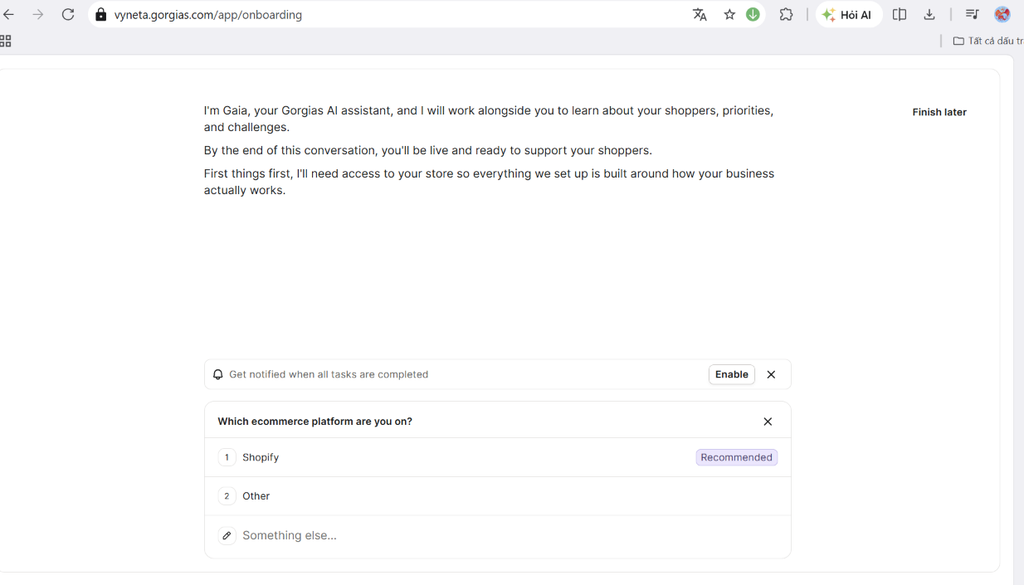
Gorgias onboarding immediately asked which ecommerce platform we used.
When we selected Other, Gorgias allowed us to enter the helpdesk dashboard, but the AI Agent setup screen clearly stated that a connected Shopify store was required.
That does not make Gorgias worse.
It simply shows that Gorgias is designed around a more specific use case:
commerce-focused customer service, especially Shopify.
Winner for setup: Tidio
AI Agent: Lyro vs Gorgias AI Agent
This is where the products differ most strategically.
Tidio Lyro AI Agent
Lyro can use business content as its knowledge source.
During our test, it learned from Vyneta pages including:
- Homepage
- About
- Contact
- Guides
- Terms of Use
- Affiliate Disclosure
We also added custom Guidance instructing Lyro not to invent:
- prices;
- features;
- policies;
- rankings;
- product recommendations.
After activating the Guidance, its responses became shorter and more disciplined.
Most importantly, when Lyro lacked information, it admitted it.
For a small business, that makes Lyro relatively easy to experiment with without first building an advanced ecommerce infrastructure.
Tidio currently includes the first 50 Lyro conversations as a lifetime free allowance, while larger Lyro quotas are available separately.
Gorgias AI Agent
Gorgias takes a more ecommerce-native approach.
Its AI Agent can use knowledge from the store website, help center, URLs, documents, guidance, and Shopify product information. Gorgias also gives each connected Shopify store its own AI Agent.
The deeper Shopify connection allows Gorgias to work with information such as:
- product data;
- order context;
- shipping information;
- customer information;
- ecommerce policies;
- product recommendations.
Gorgias also supports ecommerce-oriented AI capabilities such as its Shopping Assistant, which is designed to help shoppers discover products and move toward a purchase.
This is more powerful for the right ecommerce store.
But it also makes Gorgias less attractive if you are not running Shopify.
AI Winner
For small businesses and easier deployment: Tidio.
For Shopify ecommerce depth: Gorgias.
Live Chat and Inbox
Both platforms combine AI with human customer support.
Tidio Inbox
Tidio separates conversations into areas such as:
- Live conversations
- Tickets
- Unassigned
- My open
- Solved
- Lyro AI Agent
- Spam
For a small team, the structure is easy enough to understand.
You can begin with only chat and add additional channels later.
Gorgias Inbox
Gorgias felt more like a dedicated ecommerce helpdesk.
Its Inbox revolves around tickets and views such as:
- Assigned to me
- Unassigned
- All
- AI Agent views
- Custom shared and private views
Even before connecting a real store, the interface felt designed for teams processing customer service at scale rather than simply adding a chat bubble to a website.
Gorgias can also surface Shopify order data directly next to a support ticket and lets teams perform certain ecommerce actions without leaving the helpdesk.
Winner for lightweight support: Tidio.
Winner for structured ecommerce operations: Gorgias.
Shopify Integration: Gorgias Wins
This category is not close.
Tidio works with Shopify, but Gorgias is built much more deeply around ecommerce operations.
Connecting Shopify to Gorgias can bring order history, shipping information, and customer purchase data into the helpdesk.
Support agents can also perform actions such as refunds and cancellations from within Gorgias, depending on permissions and configuration.
AI Agent also uses Shopify product and store data to answer questions and make product recommendations.
If Shopify is the center of your business and you process significant support volume, this integration depth can save considerable time.
Winner: Gorgias
WordPress and Non-Shopify Businesses: Tidio Wins
Our own testing makes this distinction clear.
Tidio worked directly with our WordPress website.
We installed the plugin, added Vyneta URLs as knowledge sources, customized Lyro, and activated live chat without needing an ecommerce platform.
Gorgias allowed us to enter its helpdesk without Shopify, but its AI Agent could not be activated without connecting a Shopify store.
Gorgias documentation confirms that Shopify is currently required for AI Agent.
If you run:
- a WordPress content business;
- a SaaS website;
- a service business;
- a simple online business;
- or a store that is not heavily dependent on Shopify;
Tidio is the more flexible option of the two.
Winner: Tidio
Tidio vs Gorgias Pricing
The pricing models are different enough that comparing only the entry-level monthly price can be misleading.
Tidio Pricing
As of September 2026, Tidio lists:
| Plan | Starting price |
|---|---|
| Free | $0/month |
| Starter | $24.17/month |
| Growth | From $49.17/month |
| Plus | From $300/month + usage |
| Premium | Custom |
For the latest plan details and usage limits, check the official Tidio pricing page.
Starter currently includes 100 billable conversations, while Growth starts from 250.
Tidio also tracks Lyro AI conversations and Flows usage separately.
The first 50 Lyro conversations are currently free as a lifetime allowance, while paid Lyro usage starts separately from the main customer-support plans.
This means the advertised monthly plan is not necessarily your total future cost.
Gorgias Pricing
Gorgias pricing is primarily based on ticket volume rather than the number of agents.
Its official 2026 pricing guide lists:
| Plan | Starting price |
|---|---|
| Starter | $10/month |
| Basic | $60/month |
| Pro | $360/month |
| Advanced | $900/month |
| Enterprise | Custom |
For current plans and ticket limits, check the official Gorgias pricing page.
Those plans range from small ticket allowances to thousands of tickets per month.
Gorgias currently describes Helpdesk and AI Agent as one platform where Helpdesk scales by ticket volume and AI automation creates additional outcome-based usage charges.
A Gorgias ticket becomes billable when the helpdesk sends at least one message. If AI Agent completely resolves a conversation without human intervention, an additional automation fee can also apply.
Which Pricing Model Is Better?
For a very small business, Tidio is easier to enter because it has a permanent Free plan.
For a growing Shopify store, Gorgias may make more sense economically because its pricing is built around support workload rather than agent seats.
But both platforms can become more expensive as usage increases.
Before upgrading either tool, estimate:
- monthly human conversations;
- AI-resolved conversations;
- ticket volume;
- automation usage.
Winner for starting cheaply: Tidio
Winner for ecommerce usage-based scaling: Depends on your ticket volume.
Tidio Pros and Cons
Tidio Pros
- Easier setup
- Permanent Free plan
- Official WordPress plugin
- Lyro can work from website knowledge without Shopify
- Live chat, ticketing, Flows, and AI in one interface
- Good fit for solopreneurs and small businesses
- AI Guidance gives useful control over responses
- Lyro handled missing information well in our tests
Tidio Cons
- Pricing becomes more complicated as usage grows
- Human conversations, Lyro, and Flows have separate limits
- Some advanced customization requires higher plans
- Less deeply focused on ecommerce workflows than Gorgias
Gorgias Pros and Cons
Gorgias Pros
- Deep Shopify integration
- Ecommerce-first helpdesk
- Strong ticket organization
- AI Agent can use product and order context
- Built for larger ecommerce support operations
- Supports product discovery and shopping-assistant use cases
- Pricing is based on support workload rather than agent count
Gorgias Cons
- AI Agent currently requires Shopify
- Less attractive for WordPress/non-Shopify businesses
- More complex than Tidio for a solo operator
- Ticket plus automation billing takes time to understand
- Many advanced capabilities are unnecessary for very small stores
Tidio vs Gorgias: Which Should You Choose?
Choose Tidio If…
Choose Tidio if you:
- are a solopreneur;
- run a small online business;
- use WordPress;
- have a smaller ecommerce store;
- want to try AI support without major setup;
- need live chat and tickets in one simple system;
- want a Free plan before committing money.
Tidio offers the lower-friction starting point.
Choose Gorgias If…
Choose Gorgias if you:
- run a Shopify store;
- process meaningful ticket volume;
- have multiple customer-support workflows;
- need support agents to work with order data;
- want AI connected deeply to your product catalog;
- want customer support to contribute directly to ecommerce operations.
For serious Shopify support, Gorgias is the more specialized platform.
Still deciding between Tidio and Gorgias? Use our free Customer Support Decision Kit to compare both against the same support questions, integration needs and human handoff requirements. Record what each platform can actually do for your business before committing.
Our Final Verdict
Tidio and Gorgias overlap, but they are not really aimed at exactly the same customer.
Tidio is the better choice for most small and lean online businesses.
It is easier to set up, works well outside Shopify, has a permanent Free plan, and lets businesses experiment with Lyro AI without building a complex support operation first.
Gorgias is the better choice for Shopify-focused ecommerce businesses that have outgrown basic customer support.
Its strength is not simply chat or AI.
Its strength is connecting customer support to ecommerce data, product discovery, orders, tickets, and operational workflows.
For Vyneta’s typical audience of solopreneurs and small online businesses, we would start with Tidio.
For a growing Shopify store where support has become a major part of the business, we would seriously consider Gorgias.
Tidio vs Gorgias FAQ
Is Tidio better than Gorgias?
For small businesses, WordPress users, and teams wanting easier AI support, Tidio is generally the better fit.
For Shopify stores that need deeper ecommerce workflows, Gorgias is stronger.
Is Gorgias only for Shopify?
The Gorgias Helpdesk can support broader workflows, but its current AI Agent requires a connected Shopify store. Gorgias documentation says AI Agent is not supported for BigCommerce, Magento, or WooCommerce at this time.
Does Tidio work without Shopify?
Yes.
We tested Tidio directly on a WordPress website and used Lyro with website URLs as its knowledge sources.
Which is cheaper, Tidio or Gorgias?
Tidio is easier to start with because it offers a Free plan.
Gorgias starts with a low-priced Starter tier, but its billing is based on ticket volume and additional AI automation usage.
The cheaper option depends on your actual customer-support workload rather than the headline subscription price alone.
Can Tidio replace Gorgias?
For a small store with simple live chat and AI support requirements, possibly.
For a larger Shopify store that relies heavily on order context, ecommerce workflows, and ticket management, Tidio is not a direct replacement for all of Gorgias’ ecommerce-specific capabilities.
Can Gorgias replace Tidio?
Yes, for a Shopify-focused business willing to use a more ecommerce-specific and complex support platform.
For non-Shopify businesses, Tidio is usually the more practical choice.