

Affiliate Disclosure: This review contains affiliate links. If you sign up through one of these links, Vyneta may earn a commission at no extra cost to you. This does not affect our editorial conclusions.
Managing SaaS affiliate programs sounds simple until you join more than a few.
Different dashboards. Different referral links. Different commission structures. Different payout thresholds.
Reditus tries to reduce that fragmentation by putting B2B SaaS affiliate programs inside one marketplace and one affiliate dashboard.
For this Reditus review, we did not create a temporary account just to look around.
We have been using Reditus as an affiliate publisher, applying to SaaS programs, reviewing individual program terms, generating tracking links, and managing active and pending partnerships from the same account.
At the time of this review, our Vyneta account has six active SaaS partnerships, along with additional applications still pending or rejected.
That real usage gives us a clearer picture of where Reditus works well – and where affiliates still need to pay attention.
Table of Contents
Reditus Review: The Short Version
Reditus is one of the more focused affiliate platforms we have used for discovering and managing B2B SaaS affiliate programs.
For affiliates, joining Reditus is free. The marketplace gives publishers access to SaaS programs offering different combinations of recurring commissions, cookie windows, payout thresholds and advertising rules. Reditus says affiliates can manage multiple programs from a single dashboard.
That focus is the platform’s biggest advantage.
Instead of browsing a general affiliate network full of unrelated ecommerce products, coupons and consumer offers, Reditus concentrates on subscription software.
The trade-off is that Reditus is not a universal affiliate network.
Program quality varies. Applications may remain pending. Each SaaS company can set different terms. And getting accepted into Reditus itself does not guarantee that every program inside the marketplace will approve you.
For a publisher building content around SaaS, automation or B2B tools, however, the model makes sense.
Best for: SaaS reviewers, B2B content publishers, consultants, agencies and creators who want multiple software affiliate programs under one account.
Less suitable for: affiliates mainly promoting consumer goods, ecommerce products or offers outside B2B SaaS.
What Is Reditus?
Reditus is an affiliate and referral management platform built specifically around B2B SaaS.
There are effectively two sides to the product.
On the company side, SaaS businesses can use Reditus to create affiliate programs, track referrals, manage commissions and recruit partners.
On the affiliate side, publishers can join the Reditus marketplace, discover SaaS programs, apply to them and manage approved partnerships through one account.
Reditus currently says its wider network contains 27,000+ affiliates, with more than 61,000 partnerships created and millions of affiliate-generated clicks. These are vendor-reported platform figures rather than independently audited numbers, so we treat them as an indication of network scale rather than a guarantee of affiliate results.
The platform’s specialization is important.
Reditus is not trying to be another Amazon Associates or broad CPA marketplace.
It is built around software businesses where subscription pricing can make recurring affiliate commissions economically attractive.
How We Tested Reditus
Our experience with Reditus is different from a quick demo.
We created an affiliate account for Vyneta and have used the marketplace to research and apply for SaaS affiliate partnerships.
At the time of writing, our dashboard shows six active programs:
| Program | Commission shown in our dashboard |
|---|---|
| Geo Targetly | 20% |
| Positive noCRM | 30% |
| Compass | 20% |
| Reditus | 30% |
| Page Pulse | 30% |
| Parallel AI | 30% |
We have already tested and reviewed tools such as Page Pulse and Parallel AI from our Reditus partnerships.
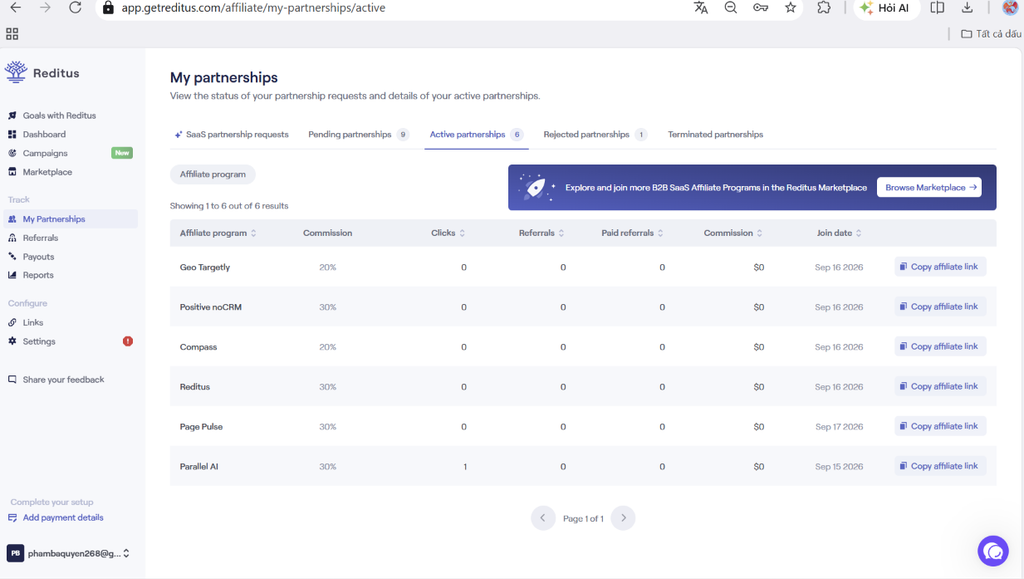
We have also experienced programs remaining in Pending status and at least one application being rejected.
We have generated live affiliate tracking links, inspected program-level commission terms, cookie windows, payout thresholds and advertising policies, and recorded initial affiliate-link activity inside the dashboard.
There is one limitation we want to make explicit:
We have not yet generated enough paid referrals to independently evaluate the full payout experience from commission creation through money arriving in our account.
So our observations about the affiliate dashboard, marketplace, applications and tracking are firsthand.
Our description of payout mechanics is based partly on Reditus’s current documentation and external user feedback.
That distinction matters.
The Affiliate Dashboard Is One of Reditus’s Strongest Features
The dashboard is straightforward.
The main navigation separates Marketplace, Partnerships, Referrals, Payouts, Reports and affiliate Links without forcing you through a complicated setup.
Once programs approve your application, they appear together under Active Partnerships.
For us, this is one of the main practical benefits of Reditus.
Instead of maintaining a spreadsheet containing several affiliate platforms and login URLs, we can see multiple SaaS partnerships inside one account.
Recent verified user reviews describe the same advantage: G2 reviewers repeatedly mention the clean interface and centralized affiliate management, while Software Advice reviewers specifically highlight being able to manage multiple SaaS programs without constantly switching dashboards.
For a one-person affiliate operation, reducing administrative overhead matters.
Every extra platform is another account, tax setup, payout configuration and dashboard to remember.
Reditus does not eliminate that problem completely, but it reduces it.
How the Reditus Marketplace Works for Affiliates
The marketplace is the part of Reditus we find most valuable.
You can browse B2B SaaS programs, inspect the offer and apply from your Reditus account.
The important point is that joining Reditus and joining an individual SaaS affiliate program are two different things.
Having a Reditus account does not mean you automatically gain access to every program.
Companies can approve or reject applicants according to their own requirements.
We have seen all three states firsthand:
Active, Pending and Rejected.
That makes the marketplace more useful than a simple directory, but it also means you should not build a commercial article around a program before you know whether your application has been approved.
That lesson directly changed how we operate Vyneta.
We now prefer to secure the affiliate relationship first, then invest in the review.
One Account Does Not Mean Identical Affiliate Terms
This is one of the most important things new Reditus affiliates should understand.
Reditus centralizes the programs.
It does not standardize all of their economics.
Each program can have its own:
commission percentage,
commission duration,
cookie window,
payout threshold,
paid advertising policy,
and affiliate terms.
For example, our Page Pulse partnership currently shows a different cookie window and commission duration from our Reditus partnership even though both live inside the same platform.
You therefore need to evaluate each SaaS program individually.
A 30% commission headline tells you very little by itself.
Thirty percent for one month is very different from 30% recurring for one or two years.
The same applies to a 30-day versus 60-day cookie.
An Important Lesson From the Reditus Affiliate Program Itself
Reditus also operates its own affiliate program inside Reditus.
Our account currently shows the Starter tier with:
30% commission,
24-month commission length,
30-day cookie,
$50 payout threshold,
and paid ads allowed.
However, Reditus’s public affiliate-program page currently advertises a broader range of 30–40% commission for 24–36 months, with a 30-day cookie and $50 threshold.
This difference is a useful real-world lesson.
Public marketing pages may describe the maximum or current range available across tiers.
Your own affiliate dashboard shows the terms actually attached to your partnership.
When the two differ, we would treat the account-level terms as the operational source of truth before publishing promotions or calculating expected revenue.
That principle applies to any affiliate network—not only Reditus.
Affiliate Links Are Easy to Manage
Approved programs appear in the Links section with a copyable tracking URL.
In our account, different products use the same Reditus affiliate identifier while pointing to each vendor’s domain.
That makes link management easier because we do not have to learn a completely different tracking system for every approved program.
For a content publisher producing multiple SaaS reviews, this starts to become meaningful.
You can focus more time on the commercial content and less time searching through six separate partner portals just to find the correct tracking URL.
Of course, centralization also means you need to be disciplined about verifying which program a link belongs to before publishing it.
Reditus Payouts: What Affiliates Should Know
Payouts deserve more attention than commission percentages.
According to Reditus’s current affiliate documentation, PayPal is the default payout method, although affiliates and individual SaaS companies can agree to alternatives such as Wise or IBAN transfers.
The affiliate normally needs to cross the payout threshold specified by that particular program. Payouts are generated according to Reditus’s monthly cycle, after which the SaaS company has a defined period to complete payment.
Reditus has also introduced automated payouts for SaaS companies on eligible plans, where Reditus handles the payments on the company’s behalf.
From an affiliate perspective, the important point is that payout experience can still depend on the program you joined.
That helps explain one recurring criticism in external reviews.
G2’s review summaries identify payout thresholds and limited payment options among the more common complaints, while verified Software Advice reviewers have also requested broader payout-method support.
We have not yet completed a paid-referral payout ourselves, so we will update this assessment when Vyneta has firsthand payout data.
Program Approval Can Be Slow
This is another limitation we have experienced directly.
Not every program responds at the same speed.
Some applications are approved relatively quickly.
Others remain pending.
This is partly outside Reditus’s control because the SaaS company ultimately decides whom it wants as an affiliate.
Verified Software Advice feedback also mentions long approval times for specific programs and asks for clearer status updates.
For publishers, there is a practical consequence:
Do not wait for pending programs before producing content for programs that are already active.
This is why we prioritize approved programs at Vyneta rather than writing reviews first and hoping monetization becomes available later.
What We Like About the Reditus Marketplace
The biggest advantage is not simply having many SaaS programs.
It is having them inside a focused ecosystem.
If your website covers automation, CRM, analytics, marketing, sales or other B2B software categories, many Reditus programs can potentially fit the same audience.
That improves what we call account/network efficiency.
One account can support several monetizable content clusters.
Reditus currently promotes itself as an affiliate network with more than 27,000 B2B SaaS affiliates and over 100 SaaS companies.
The number alone should not determine whether you join.
But the specialization is useful.
A smaller marketplace where many programs fit your audience may be more valuable than a giant marketplace where 95% of offers are irrelevant.
The Marketplace Still Requires Product Research
This is where affiliates can easily make a mistake.
A high commission does not automatically make a SaaS product worth promoting.
We still evaluate each Reditus program based on:
product relevance,
search opportunity,
real buyer intent,
product quality,
whether we can test it,
commission structure,
cookie window,
and whether the product can support a useful content cluster.
Reditus solves discovery and management.
It does not replace editorial judgment.
For Vyneta, that means we have deliberately skipped or deprioritized products even when an affiliate opportunity existed.
A trustworthy affiliate site cannot become a directory of whatever pays the highest percentage.
Reditus User Reviews: What Other Users Are Saying
External sentiment is generally positive, but there are useful recurring themes on both sides.
G2 currently shows Reditus with a strong overall rating across dozens of reviews. Common positive themes include ease of use, clean interface, support and centralized affiliate management. The more common criticisms include payout friction and requests for more flexible analytics or reporting.
Recent verified Software Advice reviews from affiliate users are particularly relevant to our use case.
Those users highlight the centralized dashboard, marketplace discovery and straightforward navigation, while complaints focus more on payout-method availability and the time some programs take to approve applications.
That is reasonably consistent with our own experience so far.
We would not treat those reviews as proof that every affiliate will have the same experience.
But the repeated themes are useful because they match several things we can observe directly.
Reditus Pros and Cons
- Pros: free for affiliates; focused specifically on B2B SaaS; multiple programs under one dashboard; easy access to individual affiliate links and program terms; recurring-commission opportunities; cleaner account management than maintaining many separate partner portals; marketplace gives publishers another way to discover software worth reviewing.
- Cons: acceptance into individual programs is not guaranteed; some applications can remain pending; affiliate terms vary widely from program to program; payout methods and thresholds may depend on individual SaaS companies; reporting may feel limited for advanced users; the B2B SaaS specialization is an advantage only if that is actually your niche.
Who Is Reditus Best For?
From the affiliate side, Reditus makes the most sense for publishers who already have—or are intentionally building—a B2B software audience.
That includes SaaS review websites, consultants, niche newsletters, business-focused YouTube channels, agencies and creators producing content around software workflows.
It is particularly attractive when you plan to promote several SaaS products.
That is where the centralized account starts saving meaningful time.
Someone interested in promoting just one product may care very little about the marketplace.
Someone planning to build twenty SaaS reviews has a much stronger reason to care.
Who Should Probably Skip Reditus?
If your audience mainly buys fashion, home products, consumer electronics or other physical goods, Reditus is not designed for your business.
The platform explicitly concentrates on B2B SaaS.
It is also unlikely to solve your monetization problem if you do not yet have any meaningful distribution channel.
Joining an affiliate marketplace does not automatically create traffic.
You still need search traffic, an audience, email distribution, social reach or another way to put the products in front of potential buyers.
And if you choose affiliate programs purely because their commission percentage looks attractive, Reditus will not protect you from poor editorial decisions.
What About Reditus for SaaS Companies?
Although our hands-on perspective in this review is primarily from the affiliate side, Reditus’s main paid software is built for SaaS companies running the programs.
The current Reditus pricing page lists a Growth plan starting at $99 per month when billed annually, with a higher month-to-month price, a Scale Up plan at $399 per month billed annually, and Enterprise pricing starting higher. Reditus currently offers a 14-day trial without requiring a credit card.
The higher tiers expand affiliate discovery, marketplace exposure, support and payout automation.
For a SaaS company, this makes the economics different from the affiliate side.
Affiliates can join free.
SaaS vendors pay for the software and network access.
That distinction is worth understanding when comparing Reditus with other affiliate-management platforms.
The Biggest Strength of Reditus
For us, the biggest strength is network efficiency.
Before evaluating affiliate economics, people often focus on whether a program pays 20%, 30% or 40%.
That matters.
But operational friction matters too.
If every SaaS requires another platform, another account and another reporting system, managing a growing affiliate portfolio becomes inefficient surprisingly quickly.
Reditus reduces that friction by putting multiple B2B SaaS partnerships in one environment.
That advantage becomes stronger as the number of approved programs increases.
The Biggest Limitation
The biggest limitation is that Reditus centralizes the network without fully centralizing the rules.
You still need to inspect every program.
Approval policy differs.
Cookie periods differ.
Commission durations differ.
Payout thresholds differ.
Advertising permissions differ.
That means Reditus should not be treated like one giant affiliate program.
It is better understood as infrastructure connecting many independent SaaS affiliate programs.
Once you understand that distinction, the platform makes much more sense.
Is Reditus Worth Using as an Affiliate?
For a B2B SaaS publisher, we think Reditus is worth exploring because the barrier to entry is low: affiliate accounts are free, and the marketplace gives you access to multiple SaaS opportunities through one system.
The value becomes much stronger if several relevant programs approve you.
That is exactly what happened with Vyneta.
Instead of depending on one SaaS partnership, we can now build content around multiple approved products while managing their tracking links from the same account.
That does not mean every Reditus program deserves a review.
It means the platform has become a useful deal-flow source for finding potential products, after which normal product research still applies.
For an affiliate publisher, that distinction is critical.
Final Verdict: A Useful Network for B2B SaaS Publishers
Reditus solves a real operational problem for SaaS affiliates.
It gives publishers one place to discover programs, submit applications, manage active partnerships, copy tracking links and monitor referrals.
Our own experience has been positive enough that Reditus is currently one of the main affiliate networks we use for building Vyneta’s SaaS portfolio.
But we would not describe it as effortless passive income.
Some applications stay pending.
Some get rejected.
Every program has different economics.
And payout experience can depend partly on the underlying SaaS company.
Those limitations are real.
They are also easier to accept when the platform is free for affiliates and several relevant partnerships can be managed from the same dashboard.
For publishers focused specifically on B2B SaaS, automation and growth tools, Reditus is a platform worth putting on the shortlist.