
SEO rarely becomes difficult because there is nothing to do.
It becomes difficult because the same work keeps coming back.
Titles need updating. Internal links need reviewing. Technical issues appear after site changes. Rankings need monitoring. Pages need refreshing. Recommendations pile up faster than a small team can implement them.
That is where an SEO automation tool can help.
But automation is only useful when it removes repetitive work without creating a new layer of complexity.
This guide explains what to automate, what to keep manual, and how to choose an SEO automation platform that fits a lean team.
Affiliate Disclosure: This article contains affiliate links. If you sign up through one of these links, Vyneta may earn a commission at no extra cost to you. This does not affect our editorial conclusions.
Table of Contents
What Is an SEO Automation Tool?
An SEO automation tool helps reduce manual work involved in monitoring, optimizing, implementing, or maintaining search performance.
That can include tasks such as:
- on-page optimization
- internal linking
- technical SEO checks
- site-wide changes
- rank tracking
- reporting
- structured data
- site-speed improvements
- identifying recurring optimization opportunities
The important distinction is that not every SEO tool actually automates SEO.
Some tools mainly find problems.
Others help you research or plan.
A true automation platform should help reduce the work required to implement or repeat changes after those opportunities have been identified.
That difference matters for small teams.
Finding another 100 SEO recommendations is not particularly useful if nobody has time to implement them.
SEO Automation Is Not the Same as AI SEO
The terms are often used together, but they are not identical.
An AI SEO tool may use artificial intelligence for tasks such as:
- content briefs
- keyword clustering
- writing assistance
- search visibility analysis
- recommendations
- competitor analysis
An SEO automation tool, however, is more focused on reducing repeated execution.
A platform can therefore use AI without automating much of your workflow.
Likewise, an automation platform can provide value even when AI is not the central feature.
For small teams, the better question is not:
Does this tool use AI?
It is:
What recurring SEO work will this tool remove from my week?
That question is much more useful when comparing platforms.
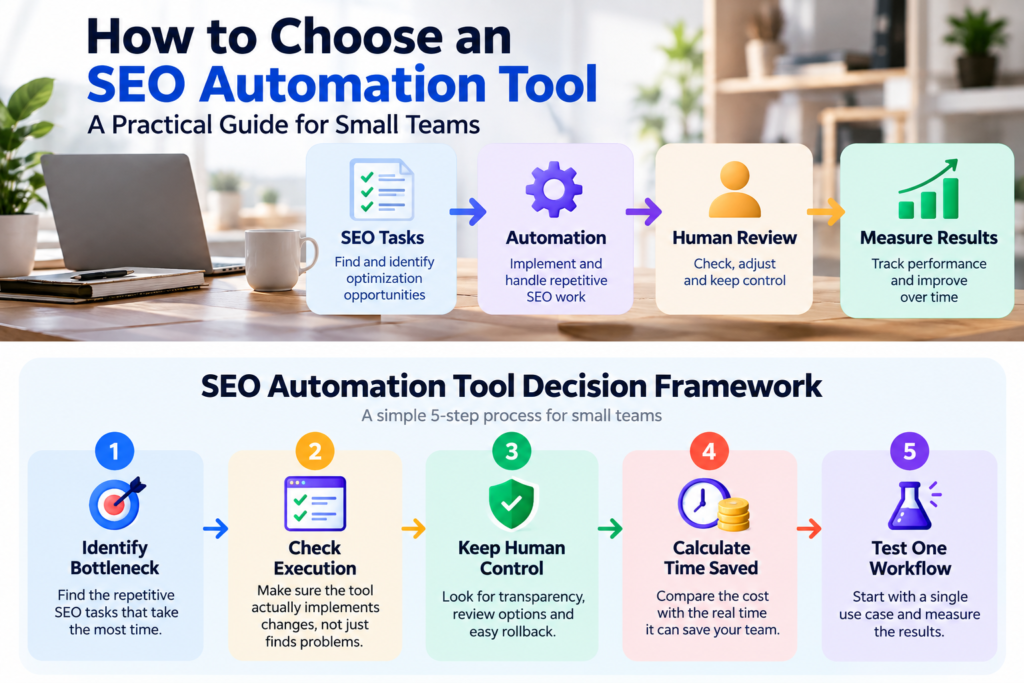
1. Start With the SEO Work You Actually Want to Automate
Do not begin by comparing feature lists.
Begin with your bottleneck.
For example, your problem might be that you regularly identify on-page issues but never have enough time to implement the changes.
Or perhaps you manage several sites and spend too much time checking rankings, internal links, site speed, and technical recommendations.
Write down the repetitive SEO tasks that consume the most time.
A simple list might look like this:
- updating on-page elements across many URLs
- finding internal-link opportunities
- monitoring keyword movement
- reviewing technical issues
- deploying repetitive optimization changes
- generating client or internal reports
Once you know the bottleneck, evaluating software becomes easier.
A tool should solve a workflow problem, not simply add more features to your stack.
2. Separate Analysis From Execution
This is one of the most important differences between SEO platforms.
Many excellent SEO tools are primarily diagnostic.
They show you:
- what is wrong
- where rankings changed
- what competitors are doing
- which pages have issues
- what keywords may be worth targeting
That information is valuable.
But analysis is not execution.
If your current stack already tells you what needs to be fixed, buying another research platform may not remove the bottleneck.
Small teams should ask:
Can this tool actually help us implement the optimization, or does it mainly produce another report?
That distinction is particularly important if your main problem is execution capacity.
3. Look for Automation You Can Control
More automation is not automatically better.
SEO changes still affect real pages, rankings, conversions, and user experience.
A useful automation platform should give you visibility into what is being changed and enough control to review or reverse important changes.
Look for workflows where you can:
- understand the recommendation
- decide whether it applies
- control deployment
- review the result
- adjust the optimization when necessary
Avoid treating SEO automation as a “set it and forget it” system.
Search intent changes.
Products change.
Competitors change.
Google changes.
Your site changes.
Automation should reduce repetitive implementation work while humans continue making strategic decisions.
4. Check Whether the Tool Works With Your Existing Website
A powerful SEO platform becomes much less useful if implementation requires a major development project.
Before choosing a tool, check:
- CMS compatibility
- installation method
- whether developer access is required
- whether source-code changes are necessary
- whether multiple websites can be managed
- how easily the tool can be removed
This matters especially for WordPress, Shopify, Webflow, SaaS websites, and sites managed by lean marketing teams.
For example, Alli AI currently says it can be installed through methods including a WordPress plugin, JavaScript snippet, or tag manager rather than requiring a full website rebuild.
That type of deployment can be useful when implementation speed is part of the problem.
5. Prioritize High-Frequency Tasks
The best automation candidates are usually tasks that happen repeatedly.
A five-minute task performed once per year does not need automation.
A fifteen-minute task repeated across hundreds of pages might.
Good candidates often include:
- recurring technical checks
- site-wide on-page changes
- internal-link management
- keyword monitoring
- reporting
- large-scale optimization updates
- repeated implementation across multiple websites
Automation becomes more valuable as frequency and scale increase.
This is also why the same SEO tool may be unnecessary for a five-page portfolio site but valuable for an agency managing dozens of client websites.
6. Do Not Automate Strategy
There are parts of SEO that should remain heavily human-led.
These include:
Search intent
Software can analyze a query, but someone still needs to understand what the searcher is actually trying to accomplish.
Editorial judgment
A tool cannot fully decide whether an article is genuinely useful, credible, or appropriate for your audience.
Product positioning
Your software does not understand your commercial priorities as well as you do.
First-hand experience
Reviews, product testing, original examples, and real observations should come from actual research or use — not automated fabrication.
Final quality control
Automation can accelerate implementation.
It should not eliminate review.
Google’s own guidance continues to emphasize original information, meaningful analysis, first-hand expertise where appropriate, and content created primarily to help people rather than manipulate rankings.
For affiliate websites in particular, that distinction is important.
Automation should support expertise, not imitate it.
7. Evaluate the Total Workflow, Not One Feature
A feature can look impressive in isolation but create extra work elsewhere.
Suppose a tool generates hundreds of recommendations.
Ask what happens next.
Do you need to export them?
Send them to a developer?
Copy changes into WordPress manually?
Review each page?
Open three other tools to measure the outcome?
The real unit of evaluation should be the complete workflow:
problem → recommendation → implementation → review → measurement
The more steps a tool genuinely removes, the more valuable the automation may be.
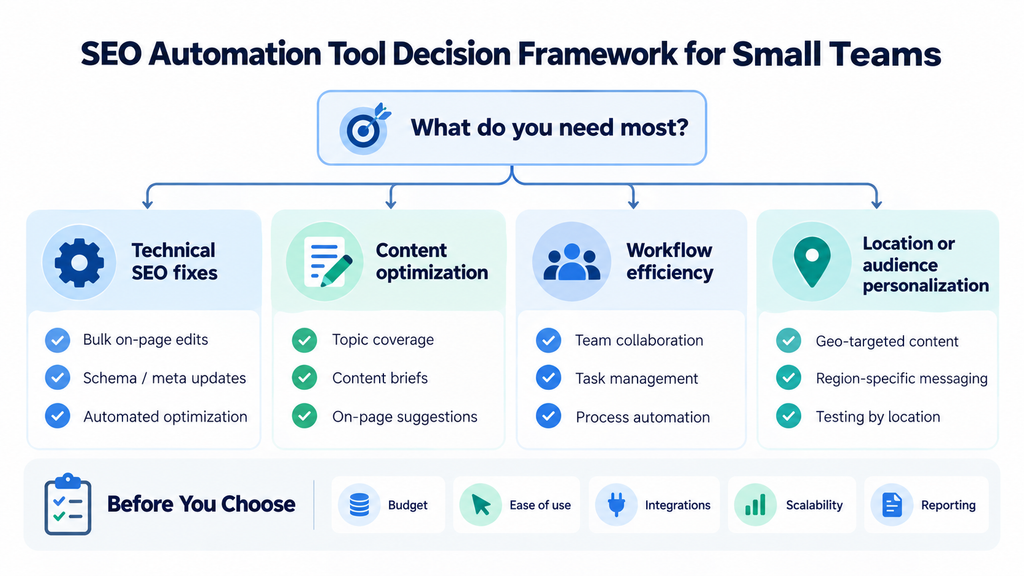
8. Consider Team Size and Website Scale
SEO automation often makes more financial sense as the number of pages, websites, or clients increases.
A freelancer managing one small website has different requirements from:
- an SEO agency
- an ecommerce business
- a SaaS company
- a content-heavy publisher
- a marketing team managing multiple domains
Do not pay for enterprise-scale automation simply because it exists.
For a small team, the goal is usually to eliminate specific bottlenecks with the smallest practical stack.
9. Compare Pricing Against Time Saved
The cheapest SEO tool is not necessarily the most economical.
Neither is the most expensive.
What matters is the relationship between:
software cost vs. implementation time saved
A $20 tool that adds two hours of manual work may be less valuable than a $200 tool that saves several hours every week.
Estimate:
- hours currently spent on repetitive SEO
- internal hourly cost
- number of sites involved
- number of pages involved
- frequency of optimization
- time needed to manage the automation itself
Then compare that figure with subscription cost.
This prevents the common mistake of evaluating SaaS purely by monthly price.
10. Be Careful With Fully Automated Content
Content automation deserves separate treatment.
Using automation to organize research, identify opportunities, generate outlines, or accelerate routine editorial tasks can be useful.
Publishing large quantities of lightly reviewed content simply because software can generate it is a very different strategy.
Google specifically warns against producing large amounts of search-engine-first content or using extensive automation primarily to attract search traffic without adding meaningful value. Google for Developers
For a lean affiliate business, fewer useful pages with clear expertise and commercial intent are generally a stronger foundation than hundreds of generic pages.
Use automation to improve your workflow.
Do not let automation become your editorial strategy.
Where Alli AI Fits
Alli AI is more relevant when your problem is SEO execution at scale rather than basic keyword research.
Its current feature set emphasizes areas such as bulk on-page optimization, internal linking, site-speed optimization, keyword tracking, and site-wide implementation.
That means it is more interesting for:
- agencies
- marketing teams
- consultants
- multi-site operators
- websites with enough pages that repetitive implementation has become a bottleneck
It is less compelling if you mainly need a lightweight keyword research tool or an AI writing assistant.
We have a separate breakdown of the platform, including its features, limitations, pricing, and fit:
And if you want to see the implementation side rather than the buying decision:
See How to Automate SEO With Alli AI →
A Simple SEO Automation Checklist
Before paying for any platform, ask these seven questions:
- What exact SEO task am I trying to automate?
- How often do we currently perform that task?
- Does the platform execute work or mainly recommend it?
- Can we review and control the changes?
- Will it work with our existing CMS and workflow?
- How much implementation time will it realistically save?
- Can we measure whether the automation improves results?
If those answers are unclear, do not buy the tool yet.
A short trial with one repeatable workflow is usually more informative than a long feature comparison.
SEO Automation Tool vs. Traditional SEO Stack
Traditional SEO stacks often consist of several specialized tools.
One might handle keyword research.
Another handles crawling.
Another tracks rankings.
Another analyzes backlinks.
Another manages content.
An SEO automation platform does not necessarily replace all of them.
Its value may instead come from reducing the gap between finding an opportunity and implementing the fix.
That means automation is often a complement to an existing SEO stack rather than a complete replacement.
For lean teams, this can still be valuable.
The goal is not to own fewer tools at any cost.
The goal is to remove unnecessary manual steps.
When an SEO Automation Tool Is Probably Worth It
Automation becomes more attractive when:
- you repeatedly discover more SEO work than you can implement
- the same changes need to be deployed across many pages
- you manage several websites
- developer availability slows SEO execution
- repetitive monitoring consumes too much time
- technical implementation is the primary bottleneck
In those situations, execution speed can become a competitive advantage.
When You Probably Do Not Need One Yet
An SEO automation platform may be unnecessary when:
- your website is very small
- you have little existing organic traffic
- you have not established basic keyword targeting
- your main problem is weak content strategy
- you rarely publish or update pages
- your SEO bottleneck is research rather than implementation
Automation cannot fix an unclear strategy.
A faster workflow only helps when you are working on the right things.
Final Thoughts
The best SEO automation tool is not the platform with the longest feature list.
It is the one that removes the most expensive repetitive work from your actual SEO process.
Start with the bottleneck.
Decide what should remain human.
Then evaluate whether automation makes the path from recommendation to implementation meaningfully shorter.
For small teams, that approach keeps the software stack lean while still capturing the biggest benefit of SEO automation: more execution without proportionally more manual work.
If implementation is already becoming your bottleneck, Alli AI is one platform worth evaluating.