
Disclosure: This guide contains affiliate links. If you purchase through them, Vyneta may earn a commission at no extra cost to you. Our recommendations are based on product research and hands-on testing where applicable.
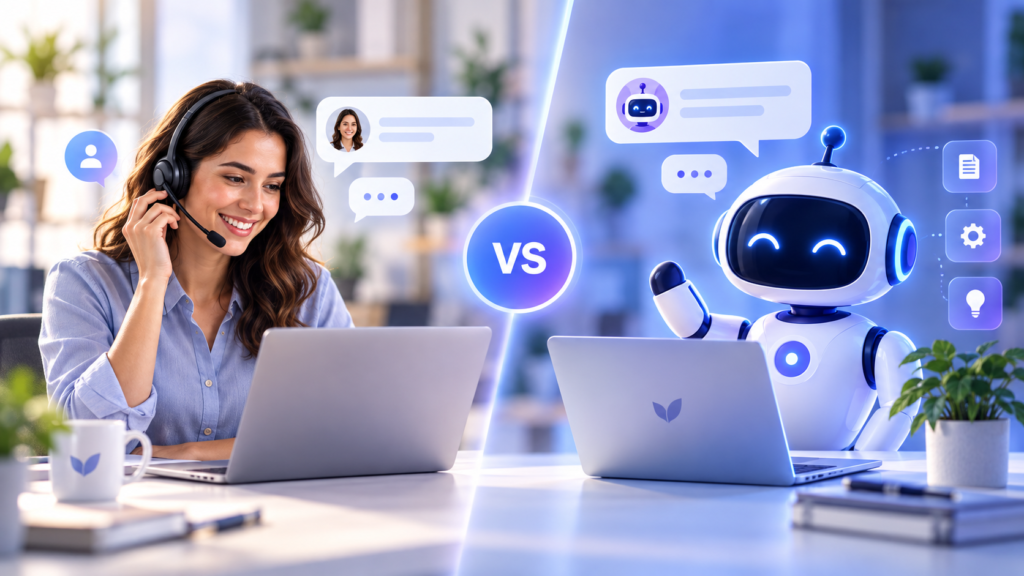
Small businesses increasingly have two ways to handle website conversations: traditional live chat with a human agent, or an AI chatbot that can answer customers automatically.
Both can improve response times. Both can reduce friction for customers. And both can become expensive or ineffective when used in the wrong situation.
The better choice depends on what your customers ask, how many conversations you receive, when those conversations happen, and how much human judgment your support process requires.
This guide compares live chat vs AI chatbot support across speed, cost, scalability, automation, customer experience, and practical fit for small online businesses.
If you are still choosing a broader support platform, start with our guide to How to Choose Customer Support Software for a Small Online Business.
Table of Contents
The Short Answer
Live chat is usually better when customers need human judgment, empathy, complex troubleshooting, or personalized advice.
An AI chatbot is usually better when your business receives repetitive questions that can be answered from clear and accurate information.
For many small businesses, the strongest setup is not choosing only one.
It is using AI for routine questions and live chat for conversations that require a person.
That hybrid approach can improve response speed without forcing AI to handle situations it is not suited for.
What Is Live Chat?
Live chat allows a visitor to communicate with a human support agent directly through a website or app.
The customer opens a chat widget, sends a message, and waits for an available person to respond.
For a small business, live chat can be valuable because it provides immediate human interaction without requiring a phone call.
A live agent can ask follow-up questions, understand context, adapt the response, and make decisions when a situation does not fit a predefined workflow.
The main limitation is availability.
If nobody is online, the customer may have to wait. As conversation volume increases, the business may also need more staff to maintain fast response times.
What Is an AI Chatbot?
An AI chatbot uses artificial intelligence to respond to customer messages automatically.
Depending on the platform, the chatbot may use website content, FAQs, help center articles, product documentation, or other knowledge sources to generate answers.
Modern AI chatbots can do more than send predefined responses.
They may also identify customer intent, summarize conversations, collect information, route requests, and hand conversations to a human when necessary.
The main advantage is scale.
An AI chatbot can handle multiple conversations at the same time and remain available outside normal business hours.
But AI still depends heavily on the quality of the information it receives.
For a deeper look at the strengths and limitations of AI, read AI Customer Support for Small Businesses: What It Can and Can’t Do.
Live Chat vs AI Chatbot: 7 Key Differences
1. Response Speed
An AI chatbot can usually respond immediately.
That makes it useful for businesses receiving questions outside working hours or handling high volumes of simple requests.
Live chat can also feel fast when an agent is available, but customers may have to wait during busy periods.
If instant first response is the priority, AI has the advantage.
If the issue requires discussion rather than a quick answer, speed alone matters less.
2. Human Judgment
This is where live chat remains stronger.
A human agent can interpret tone, recognize unusual circumstances, make exceptions, and understand situations that do not fit a standard process.
AI can assist with information and routine decisions, but it should not be expected to handle every edge case reliably.
Refund disputes, unusual billing problems, policy exceptions, account issues, or frustrated customers may still require a person.
3. Availability
AI chatbots can remain available 24/7.
That is useful for small businesses serving customers across different time zones.
Live chat availability usually depends on working hours and staffing.
A business can extend live-chat coverage, but doing so generally requires additional people or longer support hours.
If customers frequently contact you while nobody is online, AI can fill an important gap.
4. Scalability
A human agent can manage only a limited number of conversations effectively at the same time.
As support demand grows, the business may need more staff.
AI can handle many routine conversations simultaneously, making it easier to absorb increases in volume.
However, scalability only creates value when the chatbot gives accurate answers.
Automating poor answers at scale is not an improvement.
5. Cost
The economics of live chat vs AI chatbot depend on conversation volume and the software pricing model.
Live chat may be inexpensive when support volume is low and the business owner already handles customer conversations.
As volume increases, labor becomes a larger cost.
AI may reduce repetitive work, but AI features can also involve usage-based pricing, message limits, resolution fees, or higher subscription tiers.
The right comparison is not simply human salary versus chatbot subscription.
Ask how much useful work each option actually removes from your team.
6. Customer Experience
Some customers prefer talking to a person.
Others simply want a correct answer as quickly as possible.
For straightforward questions, forcing a visitor to wait for an agent creates unnecessary friction.
For complicated problems, forcing the visitor to keep talking to a chatbot can be even more frustrating.
A good support experience gives customers the fastest appropriate path to resolution.
That means AI should know when to stop and hand the conversation to a human.
7. Setup and Maintenance
Live chat is conceptually simple: connect the widget, configure availability, and have someone respond.
AI chatbots usually require more preparation.
You may need to connect knowledge sources, review answers, set escalation rules, maintain documentation, and monitor performance.
AI can reduce support work after setup, but it is not completely “set it and forget it.”
An outdated knowledge base can quickly produce outdated answers.
Live Chat vs AI Chatbot Comparison
| Factor | Live Chat | AI Chatbot |
|---|---|---|
| Response speed | Fast when agents are available | Immediate |
| Availability | Depends on staffing | 24/7 |
| Human judgment | Strong | Limited |
| Repetitive questions | Requires agent time | Strong use case |
| Scalability | Requires more staff | Handles many conversations |
| Complex issues | Strong | Usually needs escalation |
| Setup | Simpler | Requires knowledge and guardrails |
| Ongoing cost | Staff + software | Software + AI usage |
| Best fit | Complex, personal conversations | Repetitive, defined questions |
When Live Chat Is the Better Choice
In the live chat vs AI chatbot decision, live chat is usually stronger when customers regularly need personalized assistance.
Live chat is usually the stronger option when customers regularly need personalized assistance.
It is particularly useful when questions vary significantly, purchase decisions require consultation, troubleshooting is complex, or agents frequently need to make judgment calls.
Live chat can also be valuable early in a business.
Talking directly with customers helps you understand their questions, objections, and points of confusion.
That information can later be used to improve FAQs, documentation, automation, and AI support.
When an AI Chatbot Is the Better Choice
For businesses with highly repetitive questions, the live chat vs AI chatbot trade-off often shifts toward automation.
An AI chatbot becomes more attractive when a large share of support conversations are repetitive.
Typical examples include shipping questions, return policies, account instructions, product availability, feature questions, basic troubleshooting, business hours, and common pre-sale questions.
AI can also make sense when customers frequently contact you outside normal working hours.
The key is having reliable information that the AI can use.
If your documentation is incomplete or constantly changing, automation may create more work rather than less.
The Hybrid Approach Is Often Better
For many small businesses, the most practical answer to live chat vs AI chatbot is to use both.
AI handles the first layer of support.
It can answer routine questions, collect information, search documentation, and identify what the customer needs.
A human takes over when the AI is uncertain, the customer requests an agent, the issue involves judgment, or the conversation becomes sensitive or complex.
This model gives customers fast responses without pretending that every support problem can be automated.
It also allows a small team to focus its time on conversations where human attention creates the most value.

How to Choose Between Live Chat and an AI Chatbot
Start by reviewing your existing conversations.
Look at the questions customers actually ask.
If most conversations are unique and require discussion, prioritize live chat.
If a large percentage repeat the same questions, AI becomes more attractive.
Then evaluate four practical factors.
Conversation Volume
Low support volume may not justify advanced automation.
High repetitive volume gives AI more opportunity to save time.
Knowledge Quality
An AI chatbot needs accurate source material.
If your FAQs, documentation, pricing, and policies are unclear, fix those first.
Human Availability
If someone is already online during the hours customers contact you, live chat may be enough.
If customers routinely arrive while nobody is available, AI can provide useful coverage.
Economics
Estimate how much time each option saves.
Do not buy AI simply because it sounds modern.
The technology should reduce enough work or improve enough customer interactions to justify its cost.
Tidio and Gorgias: How They Fit This Decision
The tools already covered by Vyneta illustrate how support platforms can combine human conversations and automation differently.
Tidio combines live chat, a shared inbox, automation, and Lyro AI. It can be a practical option for businesses that want website conversations while also exploring AI-assisted customer support.
Read our Tidio Review 2026 →
Gorgias is more strongly focused on ecommerce customer support workflows, particularly for Shopify-based businesses.
Read our Gorgias Review 2026 →
If you are comparing the two platforms directly:
The right platform depends on more than whether it offers AI.
You also need to consider your website platform, ecommerce workflow, integrations, conversation volume, and the types of customer issues your team handles.
Questions to Ask Before Choosing
Before committing to either approach, ask yourself:
- What percentage of customer questions repeat?
- Which questions require human judgment?
- When do customers usually contact us?
- How quickly can a human respond?
- Is our support information accurate and documented?
- What happens when the AI cannot answer?
- How much will the platform cost at our expected usage?
- Can we test the workflow before committing?
These questions reveal more than simply comparing feature lists.
Test With Real Conversations
A trial should use realistic support questions.
Do not only send easy test messages such as “What are your opening hours?”
Try ambiguous questions, requests with missing information, cases requiring escalation, unusual wording, policy questions, and more complex customer situations.
For live chat, measure how quickly agents can understand and resolve the issue.
For AI, check accuracy, escalation behavior, and whether the chatbot knows when it does not have enough information.
The best support technology is the one that performs well with the messy conversations customers actually send.
Final Thoughts
The choice between live chat vs AI chatbot is not really a choice between humans and automation.
It is a decision about which conversations should be automated and which deserve human attention.
Choose live chat when judgment, personalization, and complex problem-solving matter most.
Choose AI when repetitive questions, instant responses, and 24/7 availability create meaningful value.
For many lean online businesses, combining both is the strongest approach.
Use AI to handle predictable work.
Use people where context and judgment matter.
If you are building your customer support stack from the beginning, read How to Choose Customer Support Software for a Small Online Business → and AI Customer Support for Small Businesses → next.
You can also explore Software Reviews, Software Comparisons, and Best Tools.