
Affiliate Disclosure: This comparison contains affiliate links. If you sign up for Reditus through one of our links, Vyneta may earn a commission at no extra cost to you. We do not currently use an affiliate link for PartnerStack. This does not affect our editorial conclusions.
Managing multiple SaaS affiliate programs is easier when they live under one network.
But not all networks operate the same way.
Reditus and PartnerStack both focus heavily on B2B software partnerships, yet their partner ecosystems, application processes, payout systems, and overall scale feel quite different from the affiliate side.
We have used both platforms at Vyneta.
Our PartnerStack account currently includes active relationships with Tidio and Gorgias, while our Reditus account has been used to apply to and manage several SaaS programs including Page Pulse, Geo Targetly, noCRM, Parallel AI, and Reditus itself.
That firsthand experience makes this comparison less about feature checklists and more about a practical question:
Which platform is easier and more useful for a SaaS affiliate publisher trying to build a portfolio of monetizable software reviews?
Table of Contents
Reditus vs PartnerStack: The Short Version
Both platforms can work well for SaaS affiliates.
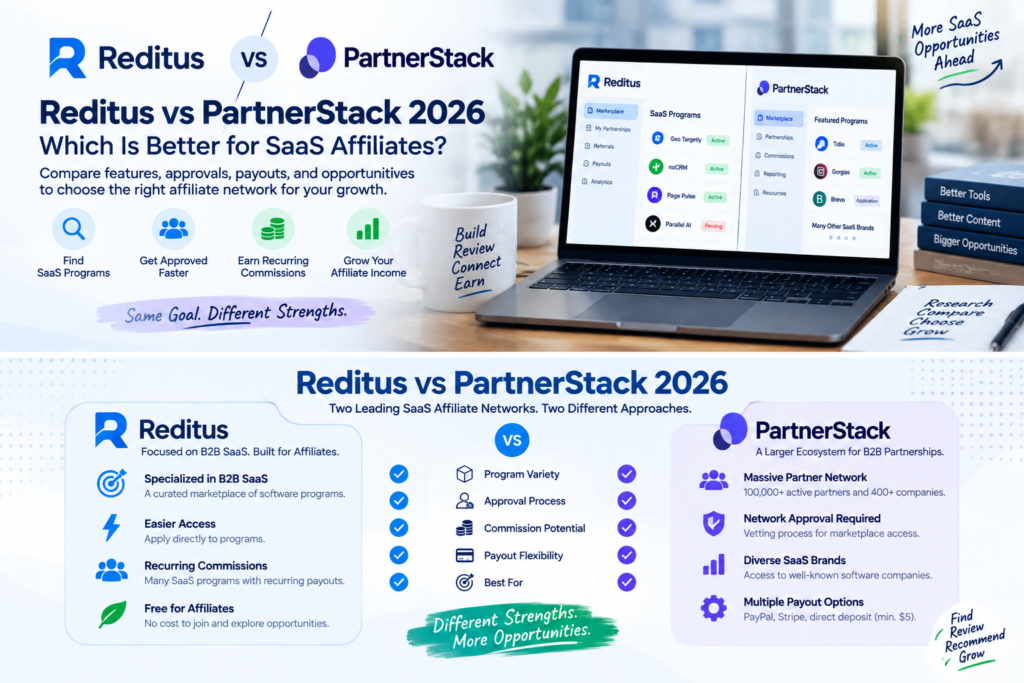
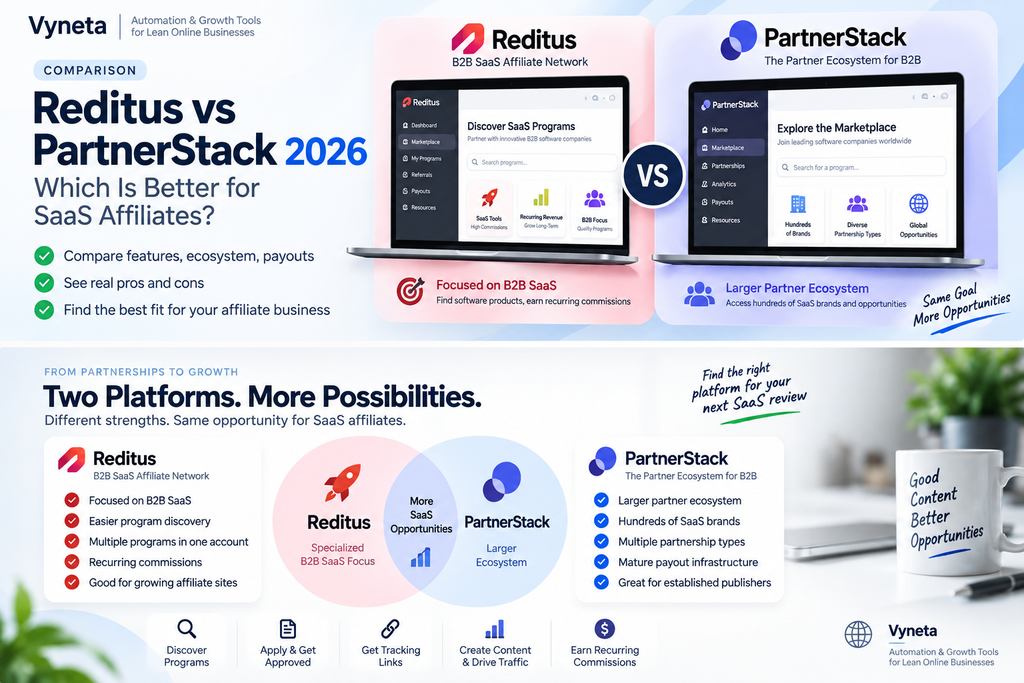
PartnerStack has the larger overall ecosystem and currently promotes access to more than 100,000 active partners and hundreds of B2B brands. Its Marketplace is designed for affiliates, referral partners, influencers, and other partner types, but access to marketplace programs requires approval to the PartnerStack Network.
Reditus is smaller and more specialized.
It focuses specifically on B2B SaaS and currently promotes a network of more than 27,000 SaaS affiliates. Affiliates can join free, browse SaaS programs, apply directly, and manage several approved partnerships from one dashboard.
For Vyneta, Reditus has currently been easier for expanding our portfolio because several relevant programs became accessible through one account.
PartnerStack remains valuable because it hosts major SaaS brands and offers a mature payout and partner-management infrastructure.
Best reason to choose Reditus: focused B2B SaaS discovery with lower account-management friction.
Best reason to choose PartnerStack: a larger partner ecosystem and access to many established software brands.
What Is Reditus?
Reditus is an affiliate and referral platform built specifically for B2B SaaS.
For affiliates, its main value is the Marketplace.
You can browse SaaS programs, inspect commission terms, apply, manage partnerships, generate referral links, and monitor referrals from one account.
Reditus currently states that joining as an affiliate is free. Its paid pricing applies primarily to SaaS companies running their own programs, with current vendor plans starting at $99 per month on annual billing.
If you want the deeper hands-on breakdown of the platform itself, see our Reditus Review.
What Is PartnerStack?
PartnerStack is a broader B2B partnerships platform.
It supports affiliate partners, referral partners, influencers, co-sell relationships, and other partner types.
Its Marketplace gives approved partners access to hundreds of software programs, and PartnerStack says its network contains more than 100,000 active partners.
For affiliates, the key distinction is the PartnerStack Network approval process.
You can create an account, but access to Marketplace programs requires a separate application to join the Network.
PartnerStack says this vetting process is intended to maintain marketplace quality and help companies identify stronger partners.
The Biggest Difference: Marketplace Access
This is the first major difference we noticed.
With Reditus, the workflow feels relatively direct:
create an affiliate account,
browse Marketplace programs,
apply to relevant products,
wait for individual program approval,
then access your tracking link after acceptance.
Individual companies can still reject or leave applications pending.
But there is no additional network-wide approval layer equivalent to PartnerStack’s Network review.
PartnerStack operates differently.
Before freely applying to Marketplace programs, partners must first be approved to the PartnerStack Network. PartnerStack says Network applications are generally reviewed within five business days, although timing can vary.
This has an important practical effect.
A PartnerStack account can continue to hold existing partnerships even if Marketplace access is limited.
But discovering and applying to new Marketplace programs depends on Network approval.
For a newer affiliate website, that extra gate can slow portfolio expansion.
Our Experience With the Approval Difference
This is one area where our firsthand experience matters.
At Vyneta, existing PartnerStack partnerships such as Tidio and Gorgias remain usable.
However, our broader PartnerStack Network application did not give us unrestricted Marketplace access.
That means we can continue working with existing approved programs, but PartnerStack is currently less useful to us for discovering new SaaS partnerships.
Reditus has worked differently.
We were able to apply to multiple programs and build an active SaaS portfolio from the same account.
Some were approved.
Some stayed pending.
Some were rejected.
That is normal affiliate-program behavior.
The key difference is that we were still able to keep exploring and applying within the Reditus ecosystem.
For a publisher trying to build ten or twenty monetized SaaS reviews, that difference can materially affect speed.
PartnerStack Has the Larger Ecosystem
Scale is PartnerStack’s clearest advantage.
Its current public pages describe a network with more than 100,000 active partners and hundreds of B2B software companies. PartnerStack also supports multiple partner models beyond standard affiliate publishing.
That scale creates more potential opportunities.
The Marketplace can include recognizable SaaS brands across productivity, marketing, sales, analytics, ecommerce, and other categories.
PartnerStack’s support documentation currently says partners can discover programs from over 400 companies through the Marketplace.
Reditus is smaller.
But size alone does not determine affiliate value.
A marketplace containing 400 programs is useful only if you qualify for them and if enough of those products fit your audience.
Reditus Is More Focused on B2B SaaS
Reditus’s narrower positioning is its strongest strategic advantage.
The company explicitly says it works specifically with B2B SaaS businesses.
Its Marketplace therefore contains far fewer irrelevant consumer offers.
Reditus currently markets access to a network of 27,000+ B2B SaaS affiliates and emphasizes recurring commissions from subscription software.
For Vyneta, that specialization is valuable.
Our site focuses on automation, SaaS, growth, analytics, and business software.
A smaller network where most programs are potentially relevant can be more efficient than a much larger ecosystem where only a small fraction fits our editorial strategy.
This is what we call network efficiency.
Reditus vs PartnerStack for Finding Affiliate Programs
PartnerStack wins on total ecosystem scale.
Reditus currently wins for us on practical access and niche concentration.
PartnerStack’s redesigned Marketplace includes search and filters for category, partner type, and commission structure, helping approved partners narrow down suitable opportunities.
Reditus also offers Marketplace discovery, but the catalog feels more concentrated around B2B SaaS.
Neither platform should be treated as a signal that every listed product deserves promotion.
We still evaluate programs based on:
product quality,
search intent,
commission structure,
cookie window,
testability,
buyer demand,
and long-term content potential.
A marketplace helps you find products.
It does not replace product research.
Application Approval: Both Platforms Still Depend on the Vendor
Getting access to the network does not mean getting accepted everywhere.
On PartnerStack, individual vendors can still approve or decline applications.
PartnerStack documentation confirms that program companies manage their own approval decisions and that waiting times vary by vendor.
Reditus works similarly at the program level.
We have personally seen Active, Pending, and Rejected statuses inside Reditus.
This means affiliates should avoid writing ten commercial reviews first and applying afterward.
Our current workflow is:
apply first,
confirm approval,
confirm tracking link,
then produce the commercial review.
That reduces wasted content.
Affiliate Dashboard Experience
Both platforms centralize multiple affiliate programs.
That alone is valuable.
Without a network, each SaaS company may require another account, another dashboard, another payout setup, and another tracking-link system.
Reditus keeps active partnerships, links, referrals, reports, and payouts in one relatively compact interface.
PartnerStack also centralizes partnerships and commissions, but its ecosystem includes more program types and therefore feels broader.
For publishers managing a small number of software programs, either approach is substantially easier than maintaining dozens of standalone affiliate accounts.
Affiliate Links
Once approved, both platforms provide program-specific tracking links.
Reditus often uses a consistent referral identifier across several SaaS domains.
For example, our Reditus partnerships use the same publisher identifier appended to different vendors’ websites.
PartnerStack similarly gives publishers tracking links through each individual program dashboard.
From a day-to-day publishing perspective, neither system is difficult.
The more important issue is making sure the landing page and tracking destination still work before publishing.
This is why we temporarily paused our Compass review when its stored Reditus link stopped leading to the live product website.
Affiliate links should be checked before every new commercial article.
Reditus vs PartnerStack Payouts
PartnerStack has a particularly mature centralized payout system.
Its current documentation says approved commissions generally become available for withdrawal around the 13th of the following month, subject to company review and payment processing.
Partners can withdraw through PayPal, Stripe, or direct deposit where available, and the minimum withdrawal amount is currently $5.
Reditus also supports centralized payouts, including automated payouts for participating SaaS programs.
However, payout thresholds can vary by individual program.
That means one Reditus program might require $20 before payout while another requires $50 or $100.
This is an important difference.
PartnerStack feels more standardized at the network-payment level.
Reditus exposes more program-specific economics.
Commission Structures
Neither platform has one universal commission rate.
Each SaaS company sets its own economics.
PartnerStack documentation gives examples ranging from percentage-based sales commissions to fixed bounties or other program-specific rewards.
Reditus also varies considerably.
Inside our current Reditus portfolio, we have seen commissions ranging from 20% to 30%, with different commission durations, cookie periods, payout thresholds, and advertising restrictions.
So comparing Reditus and PartnerStack based on one headline percentage would be misleading.
The correct comparison happens at the individual program level.
Reditus vs PartnerStack for Recurring SaaS Commissions
Both platforms support recurring SaaS commissions.
PartnerStack explicitly promotes recurring revenue-share tracking across subscription payments, renewals, and upsells when a program is configured that way.
Reditus is also heavily built around recurring B2B SaaS economics.
Its affiliate documentation says its model focuses on Cost Per Sale, with recurring commission structures common across programs.
This is one reason both platforms fit Vyneta better than networks dominated by one-time physical-product commissions.
Recurring software revenue can make a single ranking review valuable for much longer.
Which Platform Is Easier for a New SaaS Affiliate?
For a new publisher, Reditus currently feels easier to explore.
The reason is not necessarily the UI.
It is the access model.
PartnerStack’s Network vetting can improve marketplace quality, but it also creates an additional hurdle for newer websites without much traffic or referral history.
Reditus still lets individual SaaS companies decide whether they want to work with you, but the overall marketplace workflow has been more accessible in our experience.
That can matter during the earliest stage of an affiliate site.
You need enough approved programs to build monetized content.
Without them, you risk producing commercial articles that have no revenue path.
Which Platform Has Better Brands?
PartnerStack has an advantage here simply because of its scale and history.
Its public network includes hundreds of B2B companies and is used by established SaaS brands.
Reditus contains a mix of established and earlier-stage SaaS products.
That can actually create a different opportunity.
Large brands often have higher SEO competition.
Smaller SaaS products may have less search volume, but they can also have far weaker SERPs.
For a newer affiliate site, ranking for a smaller product can sometimes be more realistic than competing immediately for a famous CRM or marketing platform.
That is why we do not automatically prefer the network with the biggest brands.
Reditus vs PartnerStack for a One-Person Affiliate Business
For a solo publisher, administrative overhead matters.
Every additional network means:
another login,
another tax profile,
another payout system,
another reporting dashboard,
another set of affiliate rules.
Both Reditus and PartnerStack reduce this problem because multiple programs can live inside one account.
But for Vyneta right now, Reditus offers better account/network efficiency because we have been able to build several active programs inside the same system.
PartnerStack still earns its place because our existing Tidio Review and Gorgias Review remain monetized through it.
There is no reason to force an exclusive choice.
Do You Need to Choose Only One?
No.
This is probably the most important conclusion in the comparison.
Affiliate publishers do not need one universal network.
If a strong SaaS product runs on PartnerStack, use PartnerStack.
If another strong program runs on Reditus, use Reditus.
The goal is not platform loyalty.
The goal is to minimize account complexity while retaining access to products that genuinely fit your audience.
We prefer networks with multiple relevant programs because they reduce operational friction.
But product quality and economics still matter more than which logo appears on the affiliate dashboard.
Reditus Pros and Cons for Affiliates
Pros
- Strong B2B SaaS specialization.
- Free for affiliates.
- Multiple SaaS programs under one account.
- Good source for discovering smaller software products.
- Recurring commission structures are common.
- Program terms are easy to inspect.
- Useful for building a focused SaaS review portfolio.
Cons
- Smaller ecosystem than PartnerStack.
- Program quality varies.
- Individual applications can remain pending.
- Payout thresholds differ by program.
- Some smaller products may have limited public review history.
- Affiliate links still need manual destination checks.
PartnerStack Pros and Cons for Affiliates
Pros
- Very large B2B partner ecosystem.
- Hundreds of SaaS brands.
- Mature centralized commission and payout infrastructure.
- Multiple payout options.
- Strong program-discovery tools.
- Supports affiliate, referral, influencer, and other partnership models.
- Good access to established software brands after Network approval.
Cons
- Marketplace access requires PartnerStack Network approval.
- Newer publishers may find that gate harder to pass.
- Individual program approval is still separate.
- Large programs can be highly competitive from an SEO perspective.
- Access to a large marketplace does not guarantee acceptance by individual brands.
Who Should Prefer Reditus?
Reditus makes particular sense for:
SaaS review sites,
smaller B2B publishers,
solopreneurs,
consultants,
SEO-focused affiliate websites,
and creators trying to build a portfolio across several B2B SaaS products.
It is especially attractive when you value specialization and want several recurring SaaS programs without opening separate affiliate-platform accounts.
Who Should Prefer PartnerStack?
PartnerStack makes sense for publishers who already have a stronger business profile, audience, traffic history, or existing SaaS partnerships.
Its larger ecosystem can provide access to bigger brands and more diverse partnership models once you are Network-approved.
It may also be preferable if centralized payout flexibility is particularly important to you.
For Vyneta, we continue using PartnerStack for the programs we already have while using Reditus more aggressively for new SaaS discovery.
Final Verdict
Reditus and PartnerStack solve the same broad problem from different positions.
PartnerStack has the larger ecosystem, a more established network, and a highly structured partner-vetting and payout infrastructure.
Reditus is smaller, more tightly focused on B2B SaaS, and currently easier for us to use as a source of new affiliate programs.
For an established publisher with strong Network approval credentials, PartnerStack can unlock a large catalog of well-known SaaS brands.
For a newer or lean SaaS affiliate site, Reditus can be an efficient way to build a monetizable product portfolio without managing many independent affiliate accounts.
For Vyneta, the practical answer is not Reditus or PartnerStack.
It is:
use PartnerStack where we already have strong programs, and use Reditus where it gives us faster access to relevant new SaaS opportunities.
That approach keeps account complexity low without limiting product selection.