
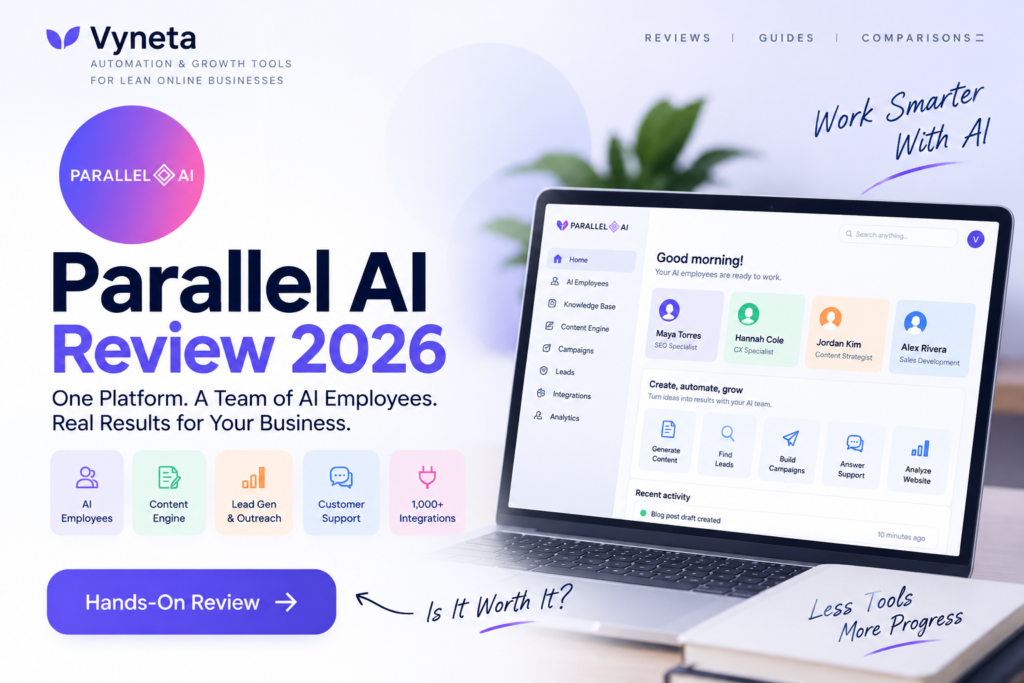
Parallel AI promises something more ambitious than another standalone AI writing tool.
Instead of giving you one chatbot or one automation builder, it positions itself as an AI workforce platform where specialized AI employees can help with sales, marketing, content, research, support, and recurring business tasks.
That sounds attractive for lean online businesses that do not want to manage a growing collection of disconnected SaaS tools.
But the important question is not how many features Parallel AI lists.
It is whether those features are useful in a real workflow.
For this Parallel AI review, we created a free account and tested the platform directly using Vyneta, our software research and recommendation website.
We tested its onboarding, website analysis, AI employees, knowledge base, Content Engine, SEO recommendations, and ability to answer questions from newly added business data.
The result was promising — but not perfect.
Disclosure: This review contains affiliate links. If you purchase through them, Vyneta may earn a commission at no extra cost to you. Our evaluation is based on hands-on testing and is not influenced by affiliate partnerships.
Table of Contents
Quick Verdict
Parallel AI is best suited to lean businesses that want several AI-driven workflows inside one platform rather than buying separate tools for every task.
During our testing, its strongest feature was not content generation.
It was the combination of:
- AI employees with specialized roles
- a shared business knowledge base
- website crawling
- content and outreach workflows
- support agents
- lead and marketing tools
Its knowledge-grounded agents performed particularly well when we asked them to distinguish between information they could verify and information missing from the knowledge base.
The biggest weakness we found was content reliability.
Its Content Engine produced polished writing, but some generated statistics were presented without verifiable sources. That means generated content still requires human fact-checking before publication.
Our current rating: 8.6/10
What Is Parallel AI?
Parallel AI is an AI business platform built around specialized AI employees.
Instead of using one generic assistant for everything, businesses can create or use agents with defined roles such as:
- SEO specialist
- customer experience specialist
- sales development representative
- GTM engineer
- content specialist
These employees can work with a shared knowledge base and connect to external business tools.
Parallel AI says its platform supports more than 1,000 integrations, while AI employees can work with internal features such as Smart Lists, Sequences, the Content Engine, and the Knowledge Base.
That makes it closer to an AI operations platform than a simple chatbot.
How We Tested Parallel AI for This Review
We did not evaluate Parallel AI from its landing page alone.
We created an account using the free Pay As You Go plan and connected it to a real website: Vyneta.com.
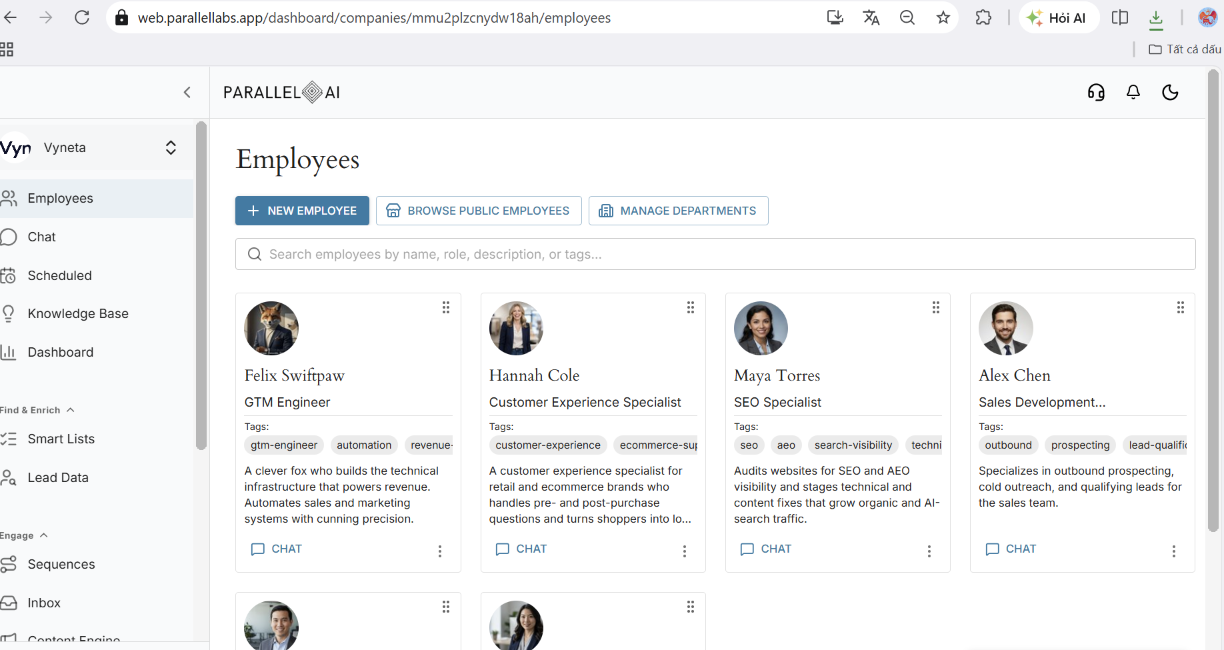
During onboarding, Parallel AI analyzed the website and automatically created:
- an ideal customer profile
- customer pain points
- a five-email sales sequence
- a content strategy
- blog and social media drafts
- AI employees
- a website knowledge base
- support-agent installation code
We then manually tested several workflows.
Test 1: SEO analysis
We asked the AI SEO specialist to audit Vyneta based only on the information available in its workspace.
The response correctly identified several opportunities and clearly stated which technical SEO factors it could not verify.
However, because its initial knowledge base contained only a small subset of Vyneta’s pages, some conclusions were outdated or incomplete.
This exposed an important limitation:
AI analysis is only as complete as the knowledge available to the agent.
Test 2: Content Engine
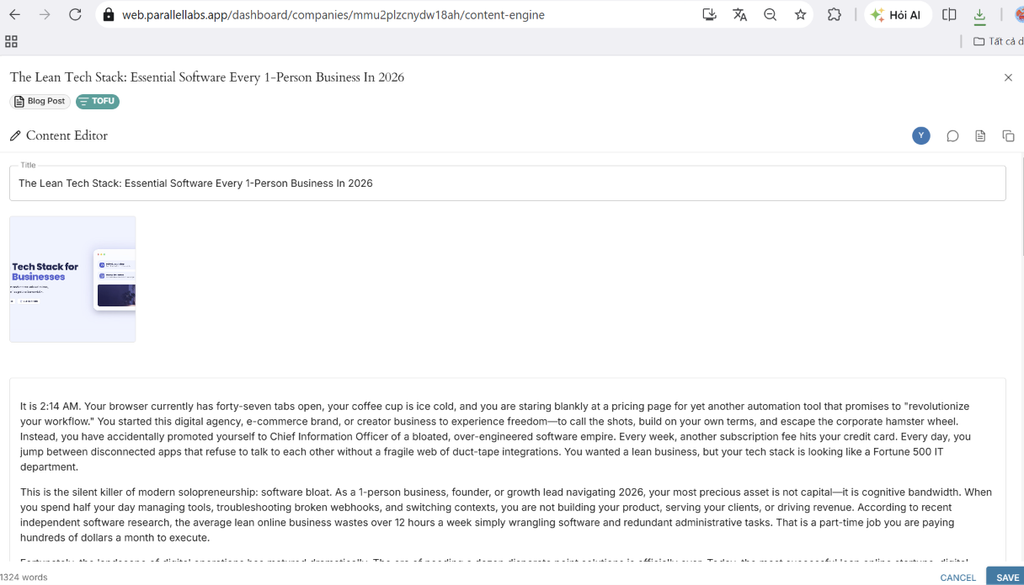
Parallel AI automatically produced a 1,324-word article titled:
“The Lean Tech Stack: Essential Software Every 1-Person Business in 2026.”
The structure and readability were good.
It produced a usable introduction, section hierarchy, examples, and a practical software-audit checklist.
But we found a significant reliability issue.
The draft included claims such as specific percentages, time savings, and productivity figures without providing sources.
That means we would not publish Parallel AI-generated content without fact-checking it first.
For us, the Content Engine works better as:
first draft → human verification → editing → SEO optimization → publication
rather than:
generate → publish automatically
This is an important distinction for businesses publishing informational or commercial content where accuracy matters.
Test 3: Knowledge Accuracy
This was where Parallel AI performed much better.
We asked its Customer Experience Specialist to explain Vyneta’s recommendations about Tidio and Gorgias while using only the existing knowledge base.
The agent separated its response into:
- information it could verify
- information it could not verify
- additional sources it would need
It specifically refused to invent pricing, test results, Lyro AI limitations, integration details, or review conclusions that were not present in its current sources.
That was a strong result.
Instead of pretending to know everything, the agent identified the gaps.
For business knowledge systems, this behavior matters more to us than producing an impressive-sounding answer.
Test 4: Updating the Knowledge Base
We then added new Vyneta content to the Parallel AI Knowledge Base.
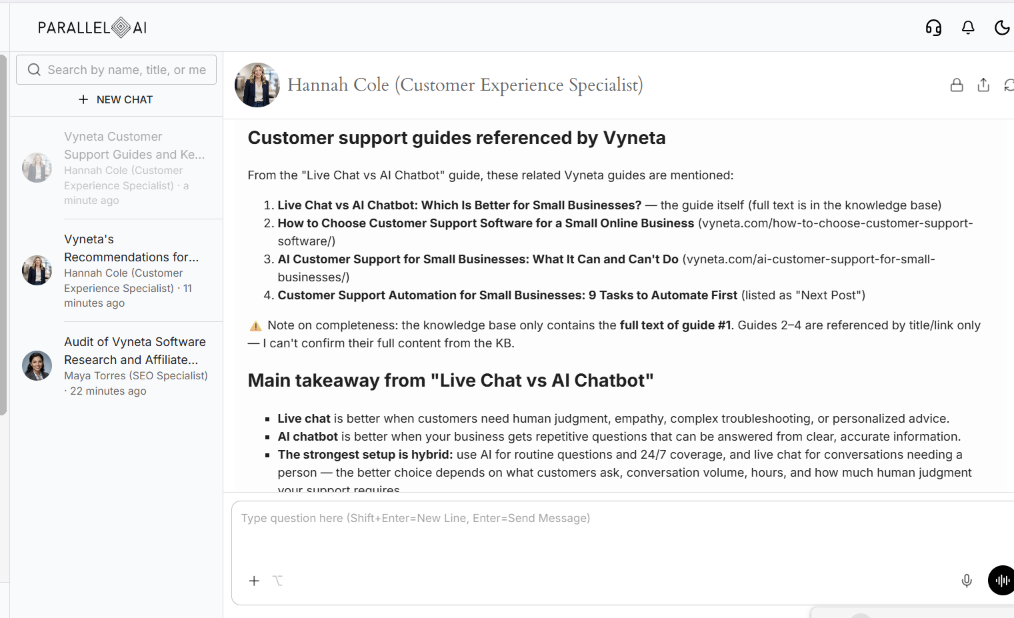
After importing our Live Chat vs AI Chatbot guide, we asked the same agent about Vyneta’s customer-support guides.
This time, the agent correctly detected the newly added article, summarized its core conclusion, identified related guides, and clearly explained which related articles existed only as references rather than full documents.
The main takeaway it extracted was accurate:
- live chat is stronger when human judgment and personalization matter
- AI chatbots work well for repetitive questions based on reliable information
- a hybrid approach can combine both
This was the strongest part of our testing.
Parallel AI’s documentation also describes the Knowledge Base as the source that AI agents use to learn about a business and supports website crawling with configurable depth.
Parallel AI AI Employees
AI Employees are one of the features that differentiate Parallel AI from basic AI chat interfaces.
Our workspace automatically included roles such as:
Maya Torres — SEO Specialist
Used for website and content analysis.
Hannah Cole — Customer Experience Specialist
Used for knowledge-grounded customer-support questions.
Other available employees covered areas such as sales development and go-to-market automation.
Parallel AI says employees can have their own role, knowledge, tools, schedules, and access to 1,000+ integrations.
The concept is useful because a business does not need to repeatedly explain every task to one generic AI assistant.
Different employees can be configured for different workflows.

Knowledge Base
The Knowledge Base was one of the best features we tested.
Parallel AI can crawl a website and turn pages into internal knowledge documents.
In our case, the initial onboarding automatically imported Vyneta pages such as:
- Home
- Tools
- Reviews
- Comparisons
- Best Tools
We later manually imported additional content.
The ability to update the knowledge base and immediately use that information in AI conversations worked well during our test.
This could be useful for:
- customer support
- internal business documentation
- sales enablement
- product information
- employee onboarding
- content research
Content Engine
Parallel AI’s Content Engine can generate different types of marketing assets inside the same workspace.
Our onboarding automatically created:
- a blog post
- an Instagram post
- a LinkedIn post
All were stored as drafts rather than published automatically.
That is a good default.
The Content Engine also supports campaign-oriented content workflows, while Parallel AI describes it as part of a broader system connecting content, sequences, agents, and lead-generation tools.
Our main warning remains the same:
Treat generated content as a draft, not verified research.
Lead Generation and Sales Sequences
Parallel AI also includes Smart Lists and multi-channel Sequences.
During onboarding, it automatically generated a five-step outreach sequence for Vyneta.
We did not connect our email account or send outreach during this review because that was not necessary for evaluating the core platform.
Parallel AI’s official training material says Smart Lists can store and enrich lead/company data and feed contacts into automated sequences.
This part of the platform is more relevant for:
- agencies
- consultants
- B2B SaaS
- businesses doing outbound sales
It may be less important for content-led affiliate websites like Vyneta.
Parallel AI Pricing
At the time of this review, Parallel AI offers a genuine free entry point.
Pay As You Go — $0/month
Includes:
- 50 starting credits
- no credit card required
- access to the platform rather than a time-limited trial
Entrepreneur — $99/month
Includes 2,000 monthly credits.
Business — $297/month
Includes 9,000 monthly credits and additional team/business capacity.
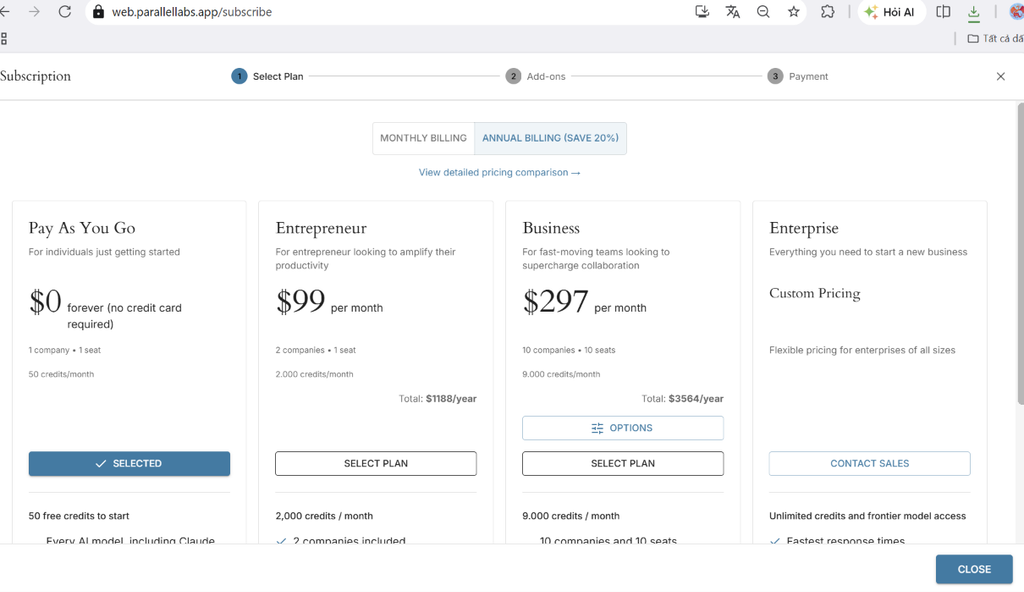
Parallel AI states that credits power AI actions such as content generation, lead enrichment, outreach, and agent conversations.
Pricing can change, so check the official Parallel AI pricing page before purchasing.
Is the Free Plan Actually Usable?
Yes.
This was one of the biggest advantages we found compared with some other AI platforms we tested.
We were able to:
- complete onboarding
- analyze Vyneta
- create business context
- generate AI employees
- create a knowledge base
- generate content drafts
- run multiple agent conversations
without entering payment information.
The free plan currently provides 50 credits.
It is enough for meaningful evaluation, although users exploring several workflows can consume those credits fairly quickly.
Integrations
Parallel AI advertises connections with more than 1,000 business tools.
Its broader platform supports workflows involving tools and systems such as CRM, email, collaboration, and knowledge software.
For small businesses, this matters because AI becomes significantly more useful when it can interact with existing workflows rather than remaining isolated inside a chat window.
We did not test all integrations during this review.
Security
Parallel AI currently reports:
- AES-256 encryption at rest
- TLS 1.2+ in transit
- role-based access controls
- MFA
- SOC 2 Type I report issued June 19, 2026
SOC 2 Type II is still listed as in progress, so it would be inaccurate to describe the company as having completed Type II certification today.
You can review the latest details in the Parallel AI security documentation.
What We Liked
1. Strong onboarding
Parallel AI did more during onboarding than most SaaS tools we test.
It used the website to create business context instead of starting with an empty dashboard.
2. Useful specialized AI employees
Having dedicated agents for SEO, customer experience, sales, and other roles creates a clearer workflow than repeatedly starting from a blank general-purpose chatbot.
3. Knowledge grounding worked well
Our strongest test results came from knowledge-based questions.
Agents correctly acknowledged missing information rather than filling every gap with invented details.
4. Real free plan
No credit card was required, and we could actually test meaningful features.
5. Broad platform
Content, support, knowledge, sales, automation, and AI agents live inside the same environment.
That could reduce tool fragmentation for some businesses.
What We Didn’t Like
1. Generated content still needs fact-checking
This was our biggest concern.
The Content Engine generated unsupported statistics in our test draft.
Anyone publishing AI-generated content should verify factual claims before publication.
2. Initial website crawling was incomplete
Parallel AI initially imported only part of Vyneta.
We had to manually add additional pages to test newer content.
3. The platform can feel broad
There are many sections: employees, knowledge, content, leads, sequences, campaigns, SEO, and more.
That breadth is valuable, but users wanting only one simple automation may find the platform larger than necessary.
4. Credits require monitoring
Even the free plan can be consumed quickly when onboarding and testing multiple agents.
Who Is Parallel AI Best For?
Parallel AI makes the most sense for:
- solopreneurs managing several business functions
- small B2B teams
- marketing agencies
- consultants
- ecommerce businesses
- SaaS companies
- businesses wanting AI support + content + sales workflows in one place
If customer support automation is your main use case, read our AI Customer Support for Small Businesses guide.
It is particularly interesting if you currently use several disconnected tools and want to consolidate workflows.
Who Should Probably Skip It?
Parallel AI may not be the right fit if:
- you only need a basic chatbot
- you only need a writing assistant
- you already have a mature automation stack that works well
- you want AI-generated content you can publish without human review
- your team does not need sales, content, support, or workflow automation
In those cases, a more specialized tool may be simpler and cheaper.
Parallel AI vs Traditional Automation Tools
Traditional automation platforms generally connect triggers and actions.
For a broader look at automating repetitive support workflows, see our Customer Support Automation for Small Businesses guide.
Parallel AI adds another layer:
AI employees + business knowledge + tools + automation.
That makes it potentially more flexible for tasks involving interpretation, research, communication, or decision support.
However, deterministic automation tools may remain preferable when a workflow must execute the same precise logic every time.
We plan to test this difference more deeply in future comparisons with tools such as Make and n8n.
Is Parallel AI Worth It?
For the right business, yes.
Our testing suggests that Parallel AI is more interesting as an AI operations platform than as a pure content generator.
The Content Engine was useful but required fact-checking.
The AI employees and knowledge system were significantly more convincing.
If you are a lean business trying to reduce the number of separate tools you use for research, content, support, sales, and automation, Parallel AI is worth testing.
The good news is that you can evaluate it on the free plan without providing a credit card.
Final Verdict
Parallel AI earned an 8.6/10 in our hands-on evaluation.
Best for
Lean online businesses that want multiple AI-driven workflows in one workspace.
Biggest strength
AI employees working from a shared and updateable business knowledge base.
Biggest weakness
Generated content can include unsupported factual claims and should not be published without review.
Pricing
Starts at $0, with paid plans currently beginning at $99/month.
Vyneta verdict
Worth testing — especially for businesses interested in AI agents, knowledge-based automation, and consolidating multiple workflows.